How to Go Off Grid: A Step-by-Step Plan for US Beginners
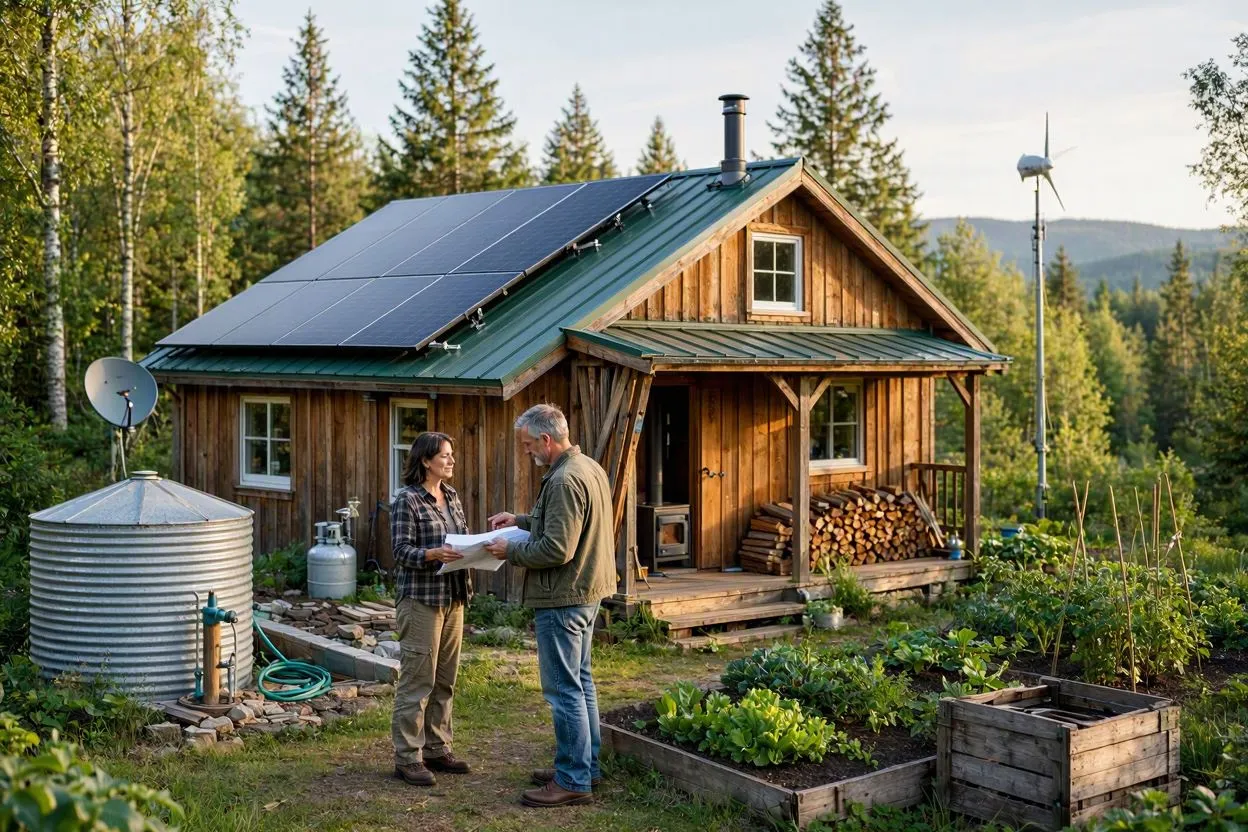
To go off grid, confirm that your county allows it, then build 4 independent systems on land that supports them: power, water, waste and heat. Food and internet come later. Excluding land, a basic whole-home setup lands close to $30,000 in 2026 when you install the solar yourself, while a professionally installed system for a larger house runs well past $100,000.
This guide explains how to go off grid in the order that saves money, with legal checks before land and land before any system gets built. Every cost below comes from a named 2026 source. The cost section covers the one tax change most guides still miss.
What Does It Mean to Go Off Grid?
Going off grid means your home runs without a public utility connection for electricity, and usually without public water or sewer. You produce your own power, pull your own water and treat your own waste on site. Most people fall into one of 2 camps.
| Type | What you disconnect | Typical starting setup | Best for |
| Partial off grid | Electricity only, or electricity plus water | Solar with batteries while keeping county water or sewer | Beginners testing the lifestyle near town |
| Full off grid | Electricity, water, sewer and gas | Solar with batteries, a well, a septic system and wood heat | Rural land with no utility lines nearby |
Partial setups cost far less. They’re easier to reverse if the lifestyle doesn’t suit you, and that matters more than most first-timers expect.
How to Go Off Grid in 9 Steps
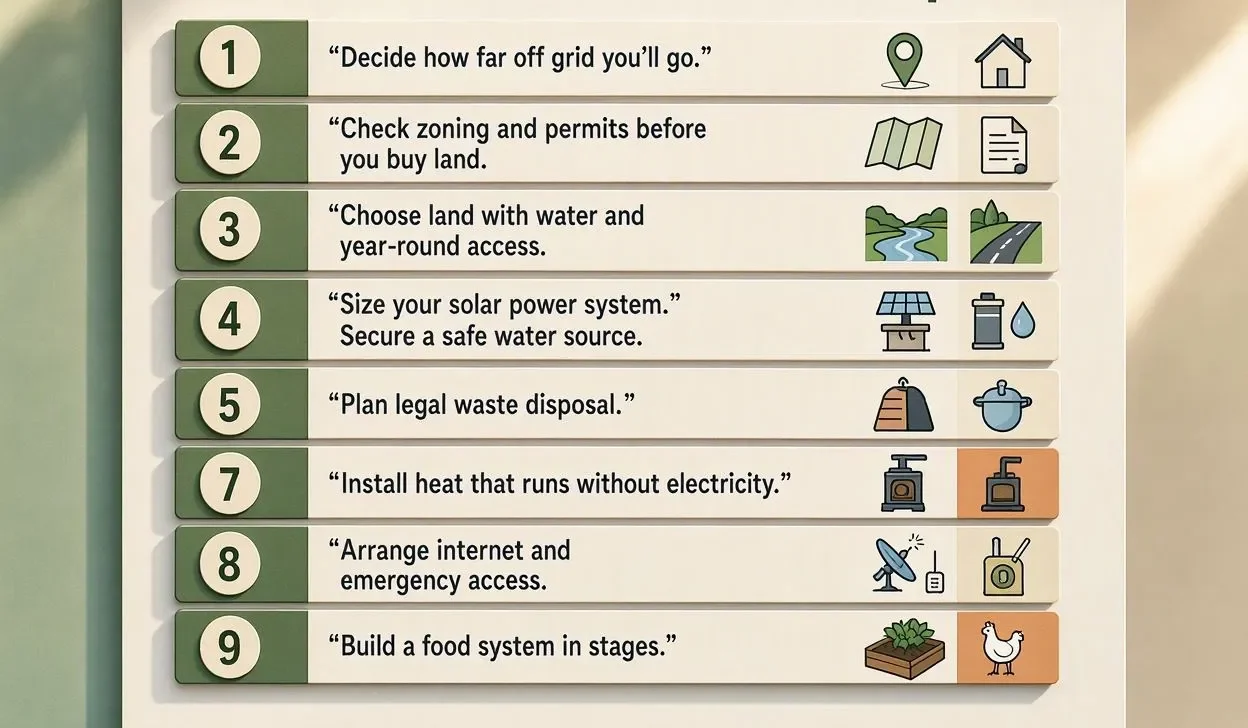
The 9 steps below run in the order that prevents expensive mistakes, starting with legal checks and ending with food.
- Decide how far off grid you’ll go.
- Check zoning and permits before you buy land.
- Choose land with water and year-round access.
- Size your solar power system.
- Secure a safe water source.
- Plan legal waste disposal.
- Install heat that runs without electricity.
- Arrange internet and emergency access.
- Build a food system in stages.
Step 1: Decide How Far Off Grid You Will Go
To decide how far off grid you’ll go, sort every appliance and habit into what you need, what you’d like and what you’ll drop. Off-grid consultant Hoss Boyd, interviewed for Briggs & Stratton’s off-grid guide, uses 3 tiers: essentials such as water and food storage, important loads such as a refrigerator or washer, and like-to-haves such as a TV or dishwasher. That list becomes your power budget in Step 4.
Rent in the area first if you can. Sandrine Coosemans, who lives off grid on a farm in Spain, writes that roughly 9 in 10 people she met with the same dream never made the move. A year of renting near your target land shows you a real winter and how the county office works, long before you’ve spent your savings. Short on money? Work-exchange stays on off-grid farms teach solar wiring and gardening at low cost.
Step 2: Check Zoning and Permits Before You Buy Land
To check zoning and permits, call the county planning or building department with the parcel number before you make an offer. No US state bans off-grid living outright. Restrictions come from county zoning and local health department rules, and they differ sharply between neighboring counties.
Ask the county these 5 specific questions:
- Minimum dwelling size: Many counties set a floor area minimum that rules out cabins and tiny homes.
- Certificate of occupancy (CO): A CO is the document that makes a structure legal to live in, and most counties won’t issue one without approved water and septic.
- Tiny house rules: The International Residential Code (IRC) Appendix AQ covers dwellings of 400 square feet (37 square meters) or less, but a code appendix isn’t adopted automatically with the rest of the code, so confirm your county uses it.
- Utility hookup mandates: Some jurisdictions require a sewer or power connection when a public line runs within a set distance of the lot.
- Well and septic permits: Both need approval, and a failed soil test can block a septic permit entirely.
Read the deed and any homeowners association (HOA) rules before closing. A private covenant can ban solar arrays or outhouses even where the county allows them.
What Western Water Rights Mean for You
In Western states that follow prior appropriation, owning land doesn’t give you the right to use the water on it. Under this “first in time, first in right” system, older water rights holders come first. Colorado shows how strict this gets: a single-family home may collect roof runoff in no more than 2 rain barrels holding 110 gallons (416 liters) combined, for outdoor use on the same property only. Rural homes with a qualifying well can apply for a separate permit to collect more. Eastern states treat rainwater far more loosely, but check with your state water agency before you design around a cistern.
Step 3: Choose Land With Water and Year-Round Access
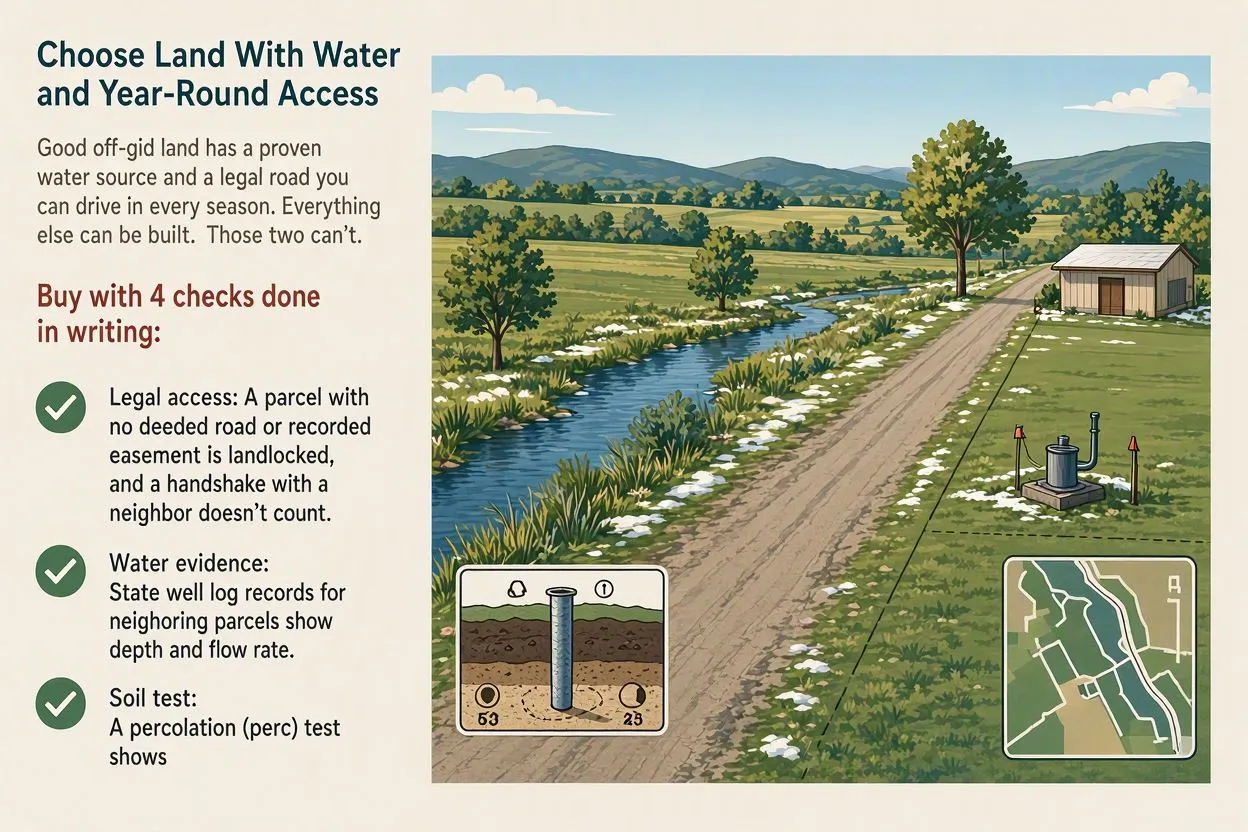
Good off-grid land has a proven water source and a legal road you can drive in every season. Everything else can be built. Those two can’t.
Buy with 4 checks done in writing:
- Legal access: A parcel with no deeded road or recorded easement is landlocked, and a handshake with a neighbor doesn’t count.
- Water evidence: State well log records for neighboring parcels show depth and flow rate.
- Soil test: A percolation (perc) test shows whether the ground can absorb septic effluent, and it costs $750 to $1,300.
- Winter sun: Stand on the building site at midday in December, since a ridge or tree line that’s harmless in July can shade panels for months.
Land prices swing widely by state. US pasture averaged $2,000 per acre in 2026 (about $4,940 per hectare), while 2025 farm real estate values ran from $725 per acre in New Mexico to $22,500 in Rhode Island. Before you close, pull the FEMA flood map and your state’s wildfire risk map, because both affect insurance.
Step 4: Size Your Off-Grid Solar Power System
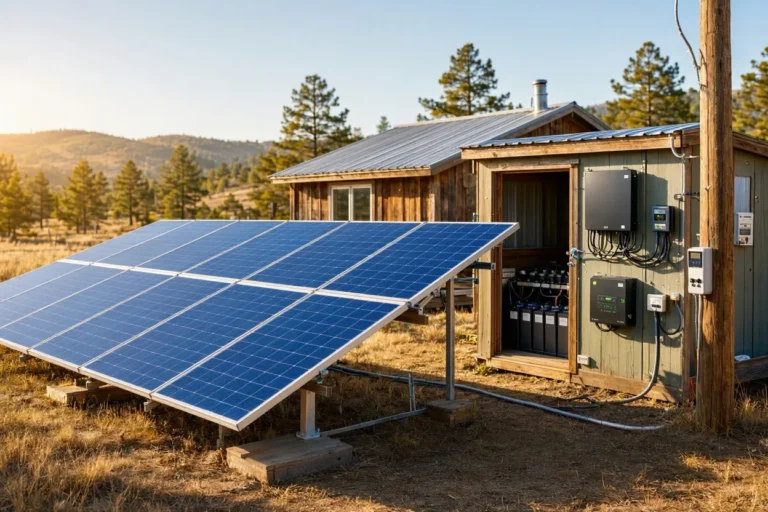
To size an off-grid solar system, divide your daily kilowatt-hour (kWh) use by your site’s peak sun hours, then add enough battery storage to cover 2 to 3 cloudy days. Batteries usually cost more than panels. Honest load numbers save thousands.
Start from a real baseline. The average US home used 865 kWh per month in 2024, per the Energy Information Administration (EIA), which works out to about 28 kWh a day. Off-grid homes run far lower because they shift space heating and water heating to wood or propane, leaving the panels to cover lights, the refrigerator, the well pump and electronics.
Worked Example: Sizing a Small Off-Grid Home
This example is hypothetical. Swap in your own numbers from Step 1.
| Input | Value | How it’s calculated |
| Daily use | 8 kWh | Refrigerator, well pump, lights, laptop, washer |
| Peak sun hours (winter) | 4 hours | Use your site’s winter figure, not the annual average |
| System losses | 25% | Wiring, inverter and heat losses (0.75 factor) |
| Solar array size | 2.7 kW | 8 ÷ (4 × 0.75) = 2.67 kW |
| Panels needed | 7 panels at 400 W | 7 × 400 W = 2.8 kW |
| Usable battery storage | 24 kWh | 8 kWh × 3 days of autonomy |
A backup generator covers the stretch when a winter storm outlasts those 3 days. Most off-grid owners run one for a few hours to recharge the battery bank instead of oversizing the array for the worst week of the year.
Code applies even when you’re off grid. The National Electrical Code (NEC) covers solar wiring in Article 690 and stand-alone systems in Article 710, and many counties require an electrical permit and inspection before issuing a CO. Hire a licensed electrician for the final connections unless you’re one yourself.
How Cold Weather Affects Off-Grid Batteries
Lithium iron phosphate (LiFePO4) batteries must never charge below 32°F (0°C). Charging a frozen cell causes lithium plating, a reaction that permanently cuts capacity. Discharging in the cold is fine. Northern owners keep the battery bank inside the heated living space or buy batteries with a built-in low-temperature charge cutoff or self-heating pads.
Step 5: Secure a Safe Water Source
A drilled well is the most reliable off-grid water source across most of the US, and most homeowners pay $3,000 to $9,000 for one. Drillers charge $25 to $65 per foot (roughly $82 to $213 per meter). Rocky or remote sites push the total higher, and deep wells with steel casing reach $24,500.
Plan storage around real demand. The average American uses about 82 gallons (310 liters) of water per person per day at home, per the Environmental Protection Agency (EPA), though off-grid households with low-flow fixtures and no lawn use far less.
Rainwater works as a primary source where state law allows it, but untreated roof runoff isn’t safe to drink. Filter it for sediment first. Then disinfect it with ultraviolet (UV) light or chlorine, since a sand-and-charcoal bucket filter clears cloudiness without reliably killing bacteria. Test well water through a state-certified lab at least once a year, and include the well pump in your solar load from Step 4.
Step 6: Plan Legal Waste Disposal
Most off-grid homes need a permitted septic system, which costs $3,593 to $12,463 for most homeowners and averages $8,017. Those Angi 2026 figures cover conventional systems. Poor soil forces an engineered design such as a mound or aerobic unit, and those run $10,000 to $20,000.
Composting toilets save water and skip the drain field. Many counties still require a septic system before they’ll issue a CO, even if you never flush. Greywater from sinks and showers can irrigate a garden in some states and needs a permit in others, so add both questions to your Step 2 call with the health department.
Step 7: Install Heat That Runs Without Electricity
An EPA-certified wood stove is the standard off-grid heat source because it needs no electricity and burns far cleaner than older stoves. New room heaters sold in the US must meet an emission limit of 2.0 grams of smoke per hour tested with crib wood, or 2.5 grams with cord wood. Older uncertified stoves release 15 to 30 grams per hour. Certified models average about 78% efficiency, so you split and haul less wood each winter.
Burn only seasoned firewood, and stack at least a full winter’s supply before the first frost. Propane is the common backup for cooking and water heating. Electric resistance heat is the one option to avoid, because a single space heater can drain a small battery bank overnight.
Design matters as much as fuel. South-facing windows and heavy insulation cut the heating load before you light the first fire.
Step 8: Arrange Internet and Emergency Access
Satellite internet from low-earth-orbit providers such as Starlink works on nearly any remote parcel with a clear view of the sky. That connection makes remote work realistic, and remote income keeps many off-grid plans alive. Confirm coverage and current plan prices on the provider’s site before you buy land, then check cell service on the FCC mobile coverage map.
Emergency access needs the same scrutiny. Time the drive from the parcel to the nearest hospital, and keep a generator or reserved battery capacity for medical devices such as a CPAP machine or oxygen concentrator. Get homeowners insurance quotes before closing. Wood heat and distance from a fire station both affect price and eligibility.
Step 9: Build a Food System in Stages
Start with a small vegetable garden and a few laying hens, then expand once your water and power systems run reliably. A garden that dies in year one because the well pump quit is the fastest way to lose a season.
Test your soil through the county extension office before planting. Raised beds fix poor native soil quickly. For low-power storage, water-bath canning and dehydrating carry a summer harvest into winter, while a root cellar keeps potatoes and squash cool with zero electricity.
How Much Does It Cost to Go Off Grid in 2026?
Excluding land, a basic whole-home off-grid setup costs close to $30,000 in 2026 with DIY solar, and professionally installed systems for large homes pass $100,000. The table shows where the money goes.
| Item | 2026 cost range |
| Land (pasture) | $2,000 per acre national average |
| Solar with batteries, DIY cabin kit | $4,000 to $8,000 |
| Solar with batteries, DIY whole home | $15,000 to $30,000 |
| Solar with batteries, installed whole home | $40,000 to $70,000 or more |
| Drilled well | $3,000 to $9,000 (average $5,500) |
| Septic system | $3,593 to $12,463 (average $8,017) |
| Perc test | $750 to $1,300 |
The 30,000figureaddsthelowendofDIYwhole-homesolar(15,000) to the average well (5,500)andtheaveragesepticsystem(8,017), for $28,517. Battery storage drives the high end, and EnergySage puts batteries for full off-grid needs at over $115,000 installed.
No federal tax credit applies to homeowner-owned solar or batteries installed in 2026. The One Big Beautiful Bill Act ended the 30% Residential Clean Energy Credit for expenditures made after December 31, 2025. State rebates still exist in some places, so search your ZIP code on DSIRE before you buy equipment.
5 Mistakes That End Off-Grid Plans Early
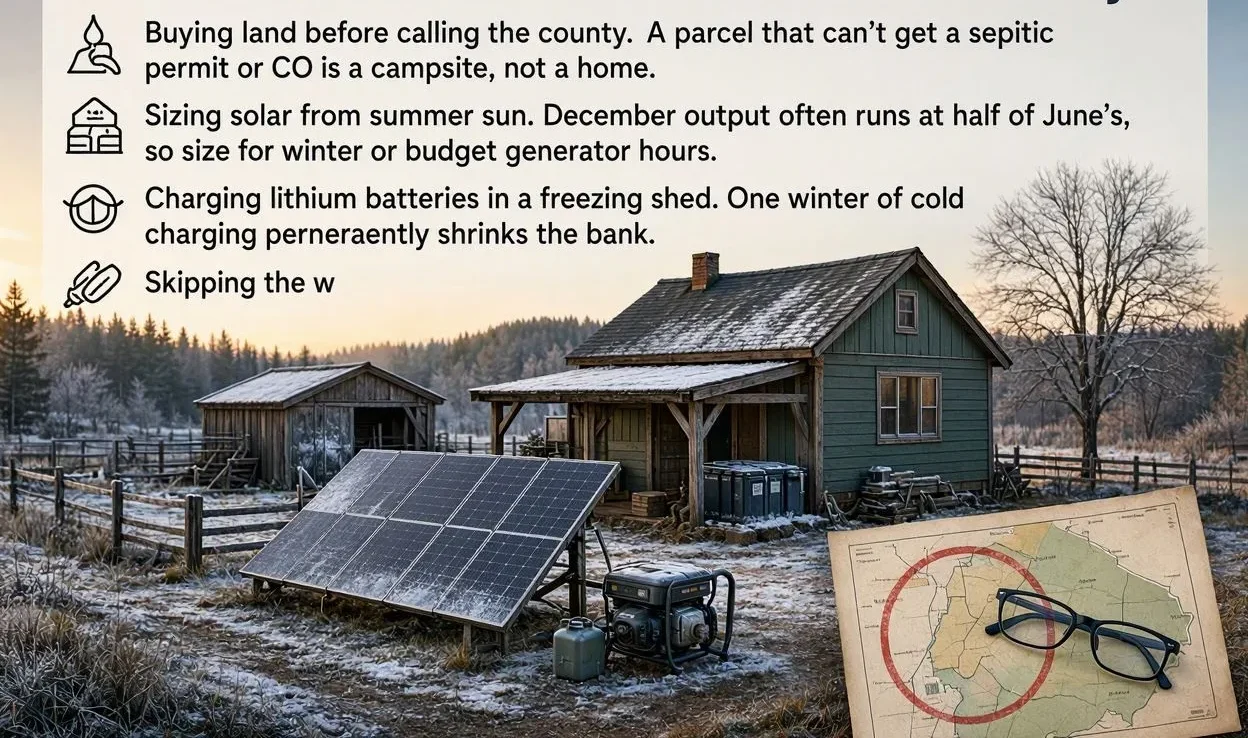
The 5 mistakes below cost the most money, and all of them happen before move-in day.
- Buying land before calling the county. A parcel that can’t get a septic permit or CO is a campsite, not a home.
- Sizing solar from summer sun. December output often runs at half of June’s, so size for winter or budget generator hours.
- Charging lithium batteries in a freezing shed. One winter of cold charging permanently shrinks the bank.
- Skipping the water test. Clear water can still carry bacteria or nitrates.
- Spending the whole budget on the build. A cash reserve covers the pump that fails in February and the delays every build hits.
Conclusion
Learning how to go off grid comes down to sequence: legal checks, then land, then the 4 core systems, with food and comfort added once those run on their own. Get the county’s answers in writing before you buy. Size power for December instead of June, and keep a cash reserve for the first hard winter.
Start small if you’re unsure. A partial setup near town teaches the same skills as a remote homestead, and it’s far cheaper to reverse. Once your plan works on paper and survives a year of renting in the area, you’re ready to build.