
Off Grid Solar Power Systems: Cost, Sizing & Best Kits
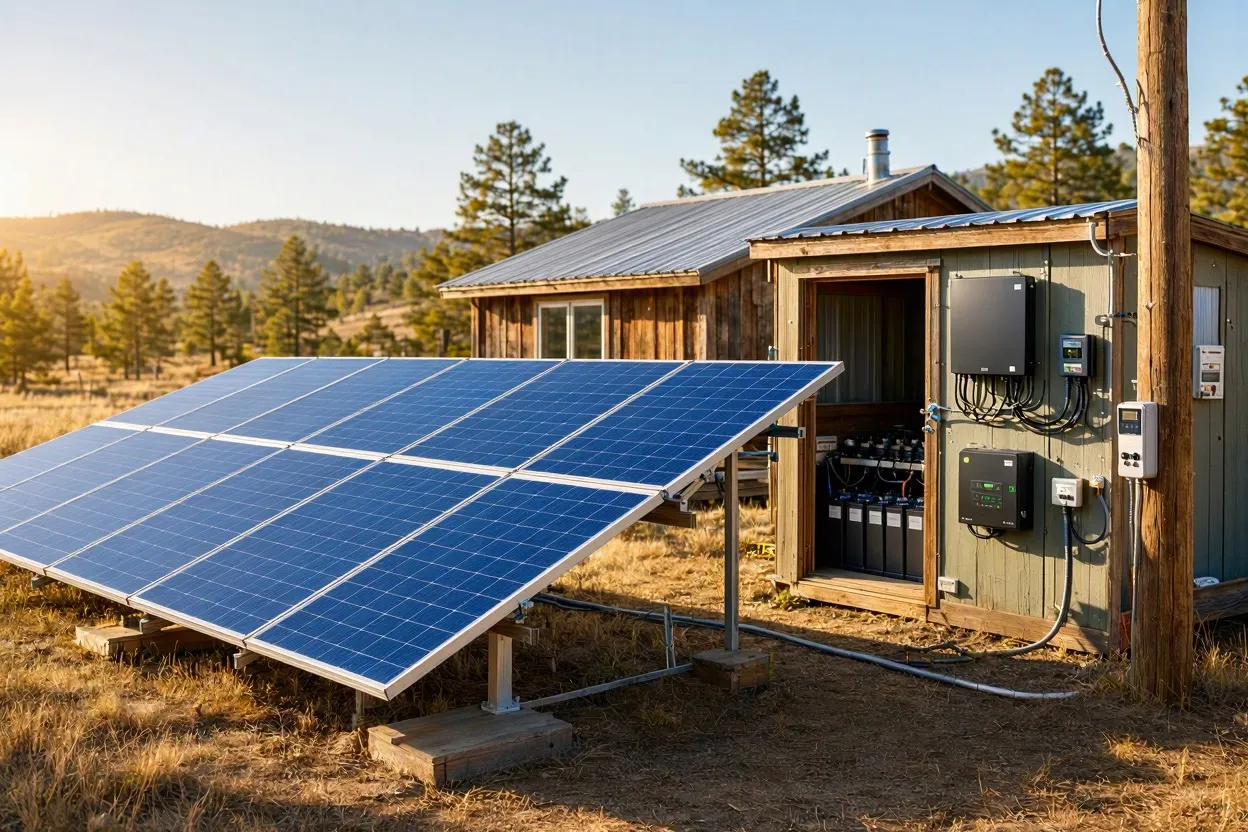
An off grid solar power system is a stand-alone setup of solar panels, a battery bank, an inverter and a charge controller that powers a building with no utility connection. Small cabin kits start near $2,000. A full family home runs $32,500 to $69,500 installed, and the 30% federal tax credit no longer applies to systems finished after December 31, 2025.
Most full-time homes need 7 to 15 kW of panels and 30 to 40 kWh of lithium storage. Where does the math work best? On remote land, because extending a power line costs $15,000 to $50,000 per mile (1.6 km), and that bill alone can exceed the price of the whole solar setup.
What Is an Off Grid Solar Power System?
An off grid solar power system generates, stores and delivers electricity on site, with no connection to a utility line. Panels charge the battery bank during daylight. After sunset, an inverter converts stored direct current (DC) into the 120/240V alternating current (AC) your outlets expect.
Somewhere between 250,000 and 300,000 US homes run this way. Most sit on rural parcels in the mountain West or on islands, places the utility never wired. Solar power off the grid systems also run hunting cabins, ranch shops and RVs, where a 2 kW kit covers lights, a fridge and a water pump.
How Off-Grid, Grid-Tie and Hybrid Systems Differ
A battery bank and the absence of a utility connection separate off-grid systems from the other 2 types. Grid-tie systems carry no battery, so they shut down during an outage on purpose to protect line workers.
| System type | Utility connection | Battery storage | Runs during an outage | Typical installed cost (home) |
| Off-grid | None | Required, 30 to 40 kWh | Yes | $32,500 to $69,500 |
| Hybrid | Yes | 10 to 20 kWh | Yes, for 8 to 24 hours | $25,000 to $50,000 |
| Grid-tie | Yes | None | No | $15,000 to $26,000 |
Hybrid systems deliver most of the outage protection at 60 to 70% of the off-grid price. That’s the smarter buy when a utility pole already stands at the end of your driveway.
What Are the 6 Main Components of Off Grid Solar Power Systems?
Every off grid solar power system needs 6 parts: solar panels, a battery bank, an inverter, a charge controller, racking and a backup generator. Kits from SunGoldPower, Signature Solar and RockSolar bundle the first 4. Racking is a different story, since RockSolar quotes mounting rails separately and plenty of sellers leave them out.
| Component | Job | Typical spec for a home | Installed cost range |
| Solar panels | Convert sunlight into DC power | 400 to 450 W monocrystalline modules, about 46 to 53 lb (21 to 24 kg) each | $7,500 to $12,000 for 10 kW |
| Battery bank | Store energy for night and cloudy days | 48V lithium iron phosphate (LiFePO4), 30 to 40 kWh | $9,000 to $24,000 |
| Inverter | Turn DC into 120/240V split-phase AC | 8 to 12 kW pure sine wave | $4,000 to $11,000 |
| Charge controller | Regulate charging from the array | Maximum power point tracking (MPPT) | $600 to $2,500 |
| Racking | Hold panels on a roof or ground mount | Ground mounts cost more than roof mounts | $2,000 to $5,000 |
| Backup generator | Recharge batteries during long cloudy spells | 8 to 12 kW propane or diesel | $3,000 to $12,000 |
All-in-one units such as the EG4 6000XP and the Growatt SPF series put the MPPT controller inside the inverter case. Fewer boxes means less wiring. It also means a single failure knocks out charging and AC output at the same time.
How to Size an Off Grid Solar Power System in 4 Steps
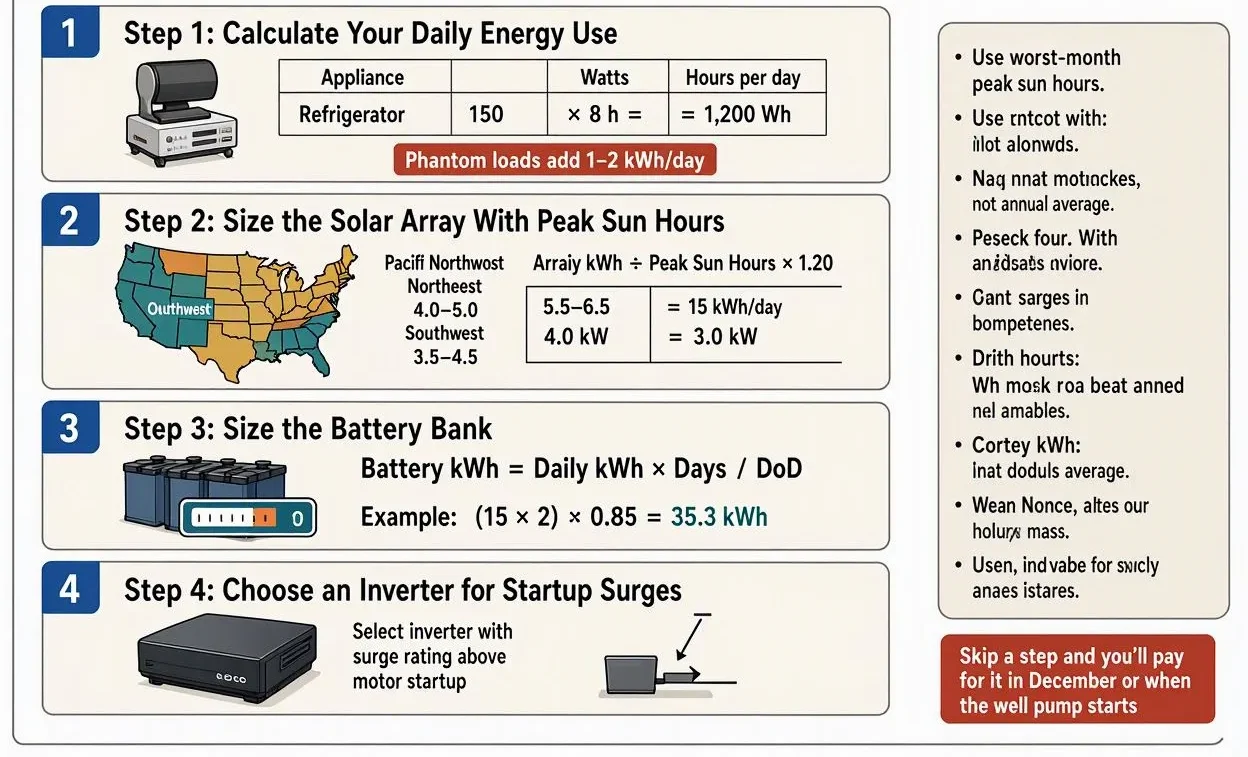
To size an off grid solar power system, total your daily kWh, divide it by your worst-month peak sun hours, size batteries for 2 days of autonomy and choose an inverter that covers startup surges. Skip a step and you’ll pay for it in December, or the first time the well pump kicks on.
Step 1: Calculate Your Daily Energy Use
To calculate daily energy use, multiply each appliance’s watts by its daily run hours, add the results and divide by 1,000 to get kWh. A refrigerator drawing 150 W across 8 hours of compressor time uses 1,200 Wh, or 1.2 kWh. Phantom loads (Wi-Fi routers, TV standby, phone chargers) quietly add 1 to 2 kWh a day.
The average grid-connected US home burns through about 30 kWh daily. Off-grid households typically settle at 10 to 20 kWh once they switch electric resistance heat to propane and run the washer at midday.
Step 2: Size the Solar Array With Peak Sun Hours
Array size in kW equals daily kWh divided by peak sun hours, multiplied by 1.20. That 1.20 factor absorbs shading, heat derating and wiring losses. Always plug in your worst month, never the annual average.
| US region | Peak sun hours | Array needed for 15 kWh per day |
| Southwest (Arizona, New Mexico, Nevada) | 5.5 to 6.5 | 2.8 to 3.3 kW |
| Southeast and Midwest | 4.0 to 5.0 | 3.6 to 4.5 kW |
| Pacific Northwest and Northeast | 3.5 to 4.5 | 4.0 to 5.1 kW |
Your exact December figure comes from a solar-resource tool such as PVWatts. Experienced designers round up generously. Panels are the cheapest part of the system, and a bigger array shortens generator hours.
Step 3: Size the Battery Bank
Battery capacity in kWh equals daily kWh times days of autonomy, divided by depth of discharge (DoD). Two days of autonomy suits most of the country. Seattle or Vermont? Plan on 3.
A home using 15 kWh a day with LiFePO4 at 85% DoD needs (15 × 2) ÷ 0.85 = 35.3 kWh. Read the usable figure on the spec sheet, not the nominal one. Growatt’s ALP 5.0L-E2 battery, for instance, lists 5.12 kWh nominal but only 4.6 kWh usable.
Step 4: Size the Inverter for Surge Loads
Choose an inverter rated for every load that can run at once, plus a 25% margin. Motors cause most sizing mistakes. Air conditioners, well pumps and fridge compressors pull 2 to 4 times their running watts for a second or two at startup, a value printed as locked-rotor amps (LRA) on the nameplate.
Most family homes land on an 8 to 12 kW inverter. A 240V submersible well pump demands split-phase output, which rules out 120V-only units like the Growatt SPF 3500TL.
Worked Example: A 4-Person Home in North Carolina
A North Carolina family using 18 kWh a day needs about a 6.4 kW array and 42 kWh of LiFePO4 storage. December delivers 3.8 peak sun hours there. The array math runs (18 ÷ 3.8) × 1.20 = 5.7 kW, rounded up to 16 panels at 400 W. Storage comes to (18 × 2) ÷ 0.85 = 42.4 kWh, and the finished install costs roughly $48,000 to $58,000.
How Much Do Off Grid Solar Power Systems Cost?
Off grid solar power systems cost $1,999 for a small 24V cabin kit and $32,500 to $69,500 installed for a 10 kW family home, with $51,000 as the national average. Kit prices cover equipment only. Labor, permits, racking and a generator push the final invoice well past the sticker.
Kit Prices From 3 Leading US Sellers
Complete off-grid kits sell for $2,000 to $22,000, depending on inverter size and battery capacity. The figures below are sale prices listed on October 9, 2026, and they shift with every promotion.
| Kit | Inverter output | Solar array | Battery storage | Listed price |
| RockSolar 2000W 24V Off-Grid Solar System | 2 kW | 900 W | 2.56 kWh | $1,999.99 |
| SunGoldPower SGK-PRO3 | 3 kW (12V DC) | 600 W | LiFePO4, size varies | From $2,346 |
| EG4 6000XP Off-Grid Kit, Signature Solar | 6 kW | Up to 7.2 kW PV input | 14.3 kWh | $6,606.31 |
| RockSolar 6kW Off-Grid Solar System | 6 kW | 4.5 kW | 14.34 kWh | $6,999.99 |
| SunGoldPower SGR-20K30E | 20 kW | 32 × 450 W | 30.72 kWh | From $15,975 |
| RockSolar 24kW Off-Grid Solar System | 24 kW | 16.2 kW | 57.36 kWh | $21,999.99 |
Bigger bundles price out far cheaper per unit of storage. The RockSolar 24 kW package works out to about $384 per kWh of battery, with panels and inverter thrown in.
What a Professional Install Costs
A professionally installed 10 kW off-grid home costs $32,500 to $69,500, and batteries eat 30 to 45% of that total. Labor and permits add $4,000 to $8,000. A 2-person Colorado cabin using 6 to 8 kWh a day lands near $28,000 to $38,000, while a high-use Arizona homestead running summer air conditioning climbs to $68,000 to $85,000.
DIY installation trims 40 to 60% off the bill for owners who know electrical work. Permits and inspections apply either way.
Is the 30% Federal Solar Tax Credit Still Available?
No, the 30% residential clean energy credit (Section 25D) is not available for systems whose installation was completed after December 31, 2025. The One Big Beautiful Bill Act, signed July 4, 2025, ended the credit 9 years ahead of schedule. A 2025 deposit doesn’t rescue it, because the IRS dates the expenditure to the day installation is finished.
On a $51,000 system, that’s $15,300 gone from the net-cost math. State tax credits and property tax exemptions survive in many states, so call your state energy office before signing a contract.
Which Battery Is Best for Off-Grid Solar: LiFePO4 or Lead-Acid?
LiFePO4 is the better battery for nearly every off-grid home, delivering 6 to 10 times the cycle life of flooded lead-acid at a 64 to 75% lower 10-year cost. Lead-acid still fits one niche: a seasonal cabin on a tight upfront budget.
| Specification | LiFePO4 | Flooded lead-acid |
| Upfront cost per kWh | $300 to $600 | $100 to $200 |
| Usable depth of discharge | 80 to 95% | 50% |
| Cycle life | 3,000 to 6,000+ | 300 to 500 |
| Calendar lifespan | 10 to 15 years | 3 to 5 years |
| Round-trip efficiency | 92 to 98% | 75 to 80% |
| Capacity loss at 32°F (0°C) | 10 to 20% | 30 to 50% |
| Maintenance | None | Monthly water checks |
Depth of discharge decides the contest. A 30 kWh lithium bank hands you 24 to 28 kWh to spend; the same nameplate in lead-acid yields 15. You’d need twice the lead to match it.
Form factor matters too. Server-rack batteries stack in 5 kWh modules, a good fit for buyers planning to expand. Wall-mount units such as the EG4 14.3 kWh WallMount save floor space in a garage or utility room.
What Is the Best Off Grid Solar Power System for Your Property?
The best off grid solar power system matches your daily kWh, your winter sun hours and your heaviest 240V load, not the biggest kit on sale. These 4 tiers reflect equipment-only kit prices from US sellers.
| Use case | Daily use | Inverter | Solar array | Storage | Kit budget |
| Weekend cabin or RV | 1 to 3 kWh | 2 to 3 kW, 12V or 24V | 600 W to 1.2 kW | 2.5 to 5 kWh | $1,400 to $4,000 |
| Full-time small cabin | 5 to 8 kWh | 3.5 to 6 kW, 48V | 2.7 to 6 kW | 10 to 15 kWh | $4,000 to $9,000 |
| Family home | 15 to 20 kWh | 8 to 12 kW, split-phase | 6 to 12 kW | 30 to 40 kWh | $10,000 to $16,000 |
| Large home or homestead | 22 to 30 kWh | 15 to 24 kW, split-phase | 14 to 16 kW | 40 to 57 kWh | $16,000 to $22,000 |
5 Checks Before You Buy a Kit
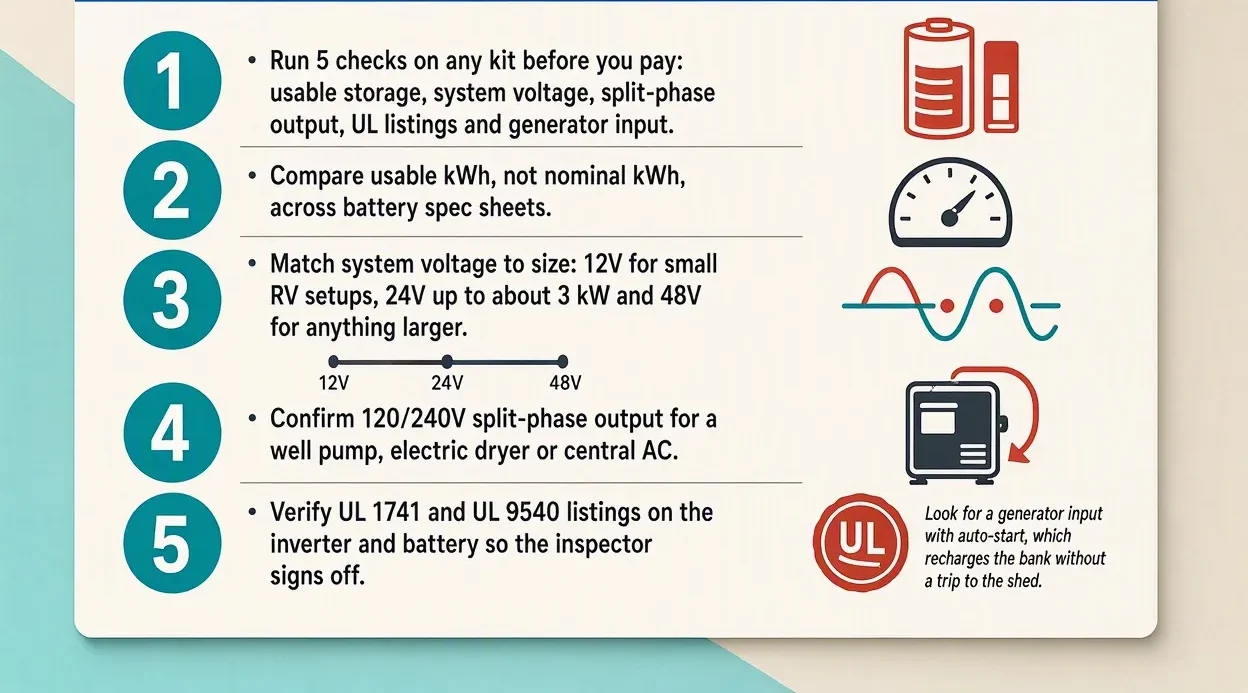
Run 5 checks on any kit before you pay: usable storage, system voltage, split-phase output, UL listings and generator input.
- Compare usable kWh, not nominal kWh, across battery spec sheets.
- Match system voltage to size: 12V for small RV setups, 24V up to about 3 kW and 48V for anything larger.
- Confirm 120/240V split-phase output for a well pump, electric dryer or central AC.
- Verify UL 1741 and UL 9540 listings on the inverter and battery so the inspector signs off.
- Look for a generator input with auto-start, which recharges the bank without a trip to the shed.
What Codes and Permits Apply to Off-Grid Solar?
Off-grid solar falls under 3 National Electrical Code (NEC) articles: 690 for photovoltaic (PV) systems, 706 for energy storage and 710 for stand-alone systems. Most US jurisdictions enforce the 2020 or 2023 NEC edition through the county building department. An unpermitted system can void homeowner’s insurance and stall a property sale.
Inspectors want to see 2 product listings. UL 1741 covers inverters and charge controllers, and UL 9540 covers the complete battery energy storage system (ESS). Rapid shutdown rules (NEC 690.12) apply to arrays on buildings, which is one reason so many off-gridders put panels on a ground mount instead.
How to Keep an Off-Grid System Running in Winter
To keep an off-grid system running in winter, size the array for December, keep LiFePO4 batteries above 32°F (0°C) while charging and keep a generator ready for long cloudy stretches. Standard lithium cells discharge fine in the cold, some down to -4°F (-20°C). Charging them below freezing is what does the damage, so self-heating batteries or an insulated enclosure pay for themselves in northern states.
Short days and snow-covered glass cut production hard. A steeper tilt angle sheds snow faster. Most off-grid homes run their generator only 30 to 100 hours a year, and an inverter auto-start signal fires it whenever the battery state of charge drops below a set point.
Should You Install Off-Grid Solar Yourself or Hire a Pro?
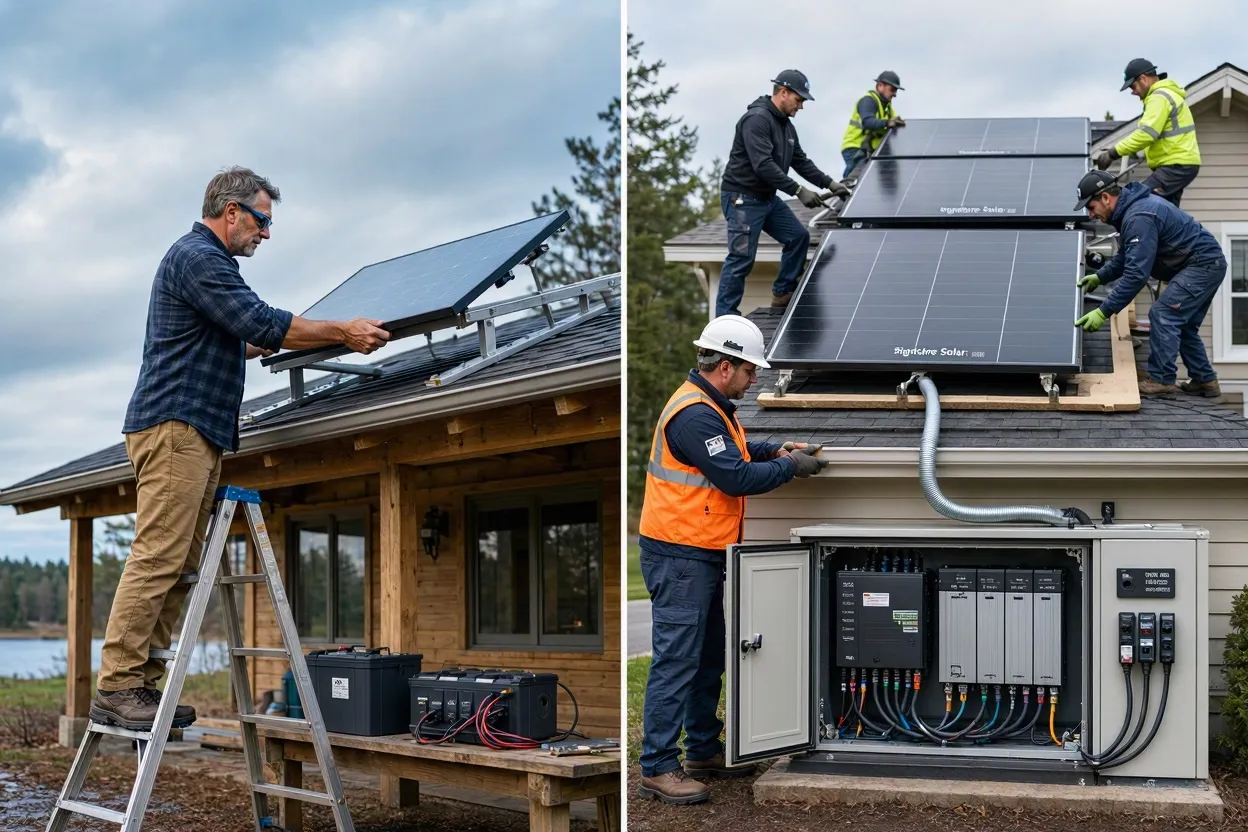
Hire a licensed electrician for any 48V home system, even when you mount the panels yourself. DIY labor saves 40 to 60%. Battery and inverter wiring, though, carries enough DC current to start fires and cause arc-flash burns.
Small 12V and 24V cabin kits are reasonable weekend projects for a handy owner. For full-home systems, Signature Solar and RockSolar both run installer networks that handle permitting and commissioning.
How Long Do Off Grid Solar Power Systems Last?
Solar panels last 25 to 30 years, while LiFePO4 batteries and inverters last 10 to 15 years. Expect one battery replacement and one inverter swap within the working life of the array.
| Component | Lifespan | Routine upkeep | Replacement cost |
| Solar panels | 25 to 30 years, losing about 0.5% output per year | Clean 2 to 4 times a year | Rarely needed |
| LiFePO4 batteries | 10 to 15 years | Annual cell-balance check | $8,000 to $20,000 |
| Inverter | 10 to 15 years | Quarterly filter cleaning, yearly terminal torque check | $2,000 to $8,000 |
| Generator | Depends on run hours | Yearly oil and spark plug change | Varies by model |
Set aside $300 to $800 a year for upkeep. That figure covers the generator service, a battery health check and occasional panel cleaning.
Conclusion
Off grid solar power systems make the most financial sense on land that a utility cannot reach for less than the price of the system itself. Everyone else gets better value from a hybrid setup with grid backup.
Start with an appliance-by-appliance load list. December sun hours should drive the array size, and a full-time home deserves LiFePO4 storage with split-phase output. Budget for racking, a generator and a permitted install from day one, because the 30% federal credit is gone and those costs land entirely on you.