Free Land in Alaska in 2026: The Truth About Land Sales, Remote Lots & Costs
Let’s answer the question directly, because most articles bury it: no, Alaska does not give away free land in 2026. Not to residents, not to newcomers, not to homesteaders. Federal homesteading ended decades ago — the last homestead patent in the entire United States was issued in Alaska in 1988 — and the state’s own Department of Natural Resources says plainly that homesteading on federal land is no longer available. Any website telling you otherwise is recycling a myth.
Here is what Alaska actually offers instead, and it is genuinely interesting: some of the cheapest legitimate land in America, sold through three official state programs — auctions, fixed-price over-the-counter sales with remote parcels historically starting around $1,900, and a stake-it-yourself program that is the closest thing to modern homesteading anywhere in the country. The catch is never the price. The catch is everything that comes after the price, and this guide covers that part honestly, because a cheap remote parcel in Alaska is one of the easiest ways in American real estate to buy something you cannot actually use.
Historic homesteading vs. what exists now:
Four categories get mixed together in every free-Alaska-land rumor, so here is the clean separation. Historic homesteading — free federal land for settlers — ended under the Federal Land Policy and Management Act; Alaska got a ten-year extension, which is why its last homestead dates to the 1980s. Federal land today — about 60 percent of Alaska — is managed by agencies like BLM and the National Park Service and is not available to claim, stake, or homestead; even mining claims convey mineral rights, not land ownership. State land sales are the real pathway: Alaska’s DNR sells surveyed, appraised parcels through three structured programs. And municipal opportunities exist at the borough level — Matanuska-Susitna, Kenai Peninsula, and Fairbanks North Star boroughs periodically auction borough-owned parcels, often more road-accessible than state offerings.
| Free land in Alaska 2026: |
The three real DNR programs, verified for 2026
| Program | Who can buy | How it works | Cost reality |
| State Land Auctions | Alaska residents only (commercial/ag parcels excepted) | Sealed bids on surveyed, appraised parcels; highest bid at or above appraised value wins. Auction #498: bid June 10–Sept 30, 2026; auction event Oct 21, 2026 | Minimum bid = fair market value — competitive parcels go higher |
| Over-the-Counter (OTC) | Anyone — residents and non-residents | Parcels unsold at auction listed first-come, first-served at fixed price, year-round | Historically 1–40 acre remote parcels from ~$1,900 to $40,000 |
| Remote Recreational Cabin Sites (RRCS) | Alaska residents only | Stake your own parcel in a designated area, lease it while DNR surveys and appraises, then purchase at market value | Closest thing to modern homesteading — but you pay market value at the end |
All three run through dnr.alaska.gov/mlw/landsales, where every parcel listing includes a site report covering access, wetlands, flood plains, and deed restrictions. Read that report as if your budget depends on it, because it does.
The PFD, explained without the hype:
The Permanent Fund Dividend is the other half of every “Alaska pays you to live there” headline, so here is what it actually is: an annual payment to eligible Alaska residents from the earnings of the state’s oil-wealth fund. The amount is set each year through the state’s political process and has varied widely — it is not fixed, not guaranteed, and not designed to fund a land purchase. Eligibility requires living in Alaska for a full calendar year before applying, intending to remain indefinitely, and meeting physical-presence rules; applications run January 1 through March 31 at pfd.alaska.gov. Think of the PFD as a welcome perk of residency that arrives after you have already committed to Alaska — never as income to underwrite a move.
What a cheap remote parcel actually costs:
This is the section that separates this guide from the listicles, because in remote Alaska the purchase price is routinely the smallest number in the project.
- Access: many OTC parcels have no road access — reaching them means boat, snowmachine, ATV easement, or bush plane. A “fly-in” parcel can mean hundreds of dollars per trip, every trip, forever.
- Survey and title work: verify corners and easements before buying; resurveying remote land costs thousands.
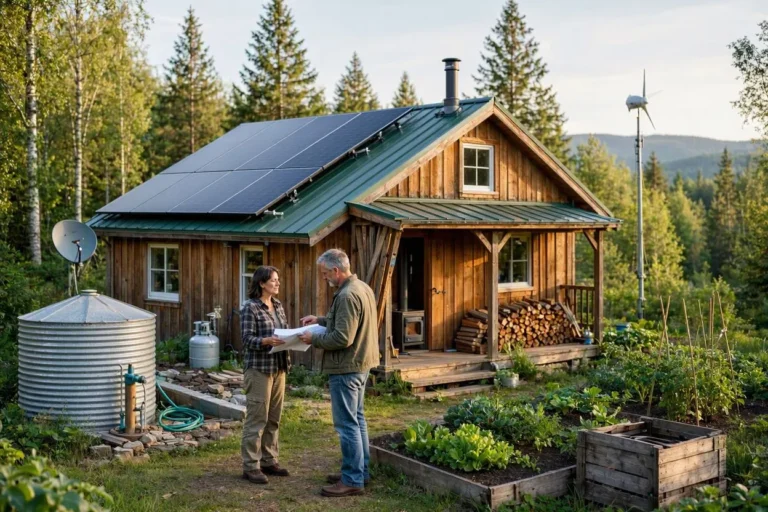
- Utilities: assume none. Off-grid power (solar plus generator for the dark months), water hauling or a well, and a septic or approved alternative are all on you.
- Wells and septic: drilling in remote Alaska can run $15,000–$40,000+ where feasible at all; permafrost and bedrock make some parcels effectively undrillable — the site report is your first clue.
- Freight: every sheet of plywood, bag of concrete, and appliance travels by barge, plane, or winter haul road. Materials can cost two to three times Lower-48 prices delivered.
- Weather and season: the realistic building window in much of the state is May through September. Plan a two-season build, not a summer project.
- Property tax: borough parcels carry normal property taxes; some remote land sits outside any organized borough, which means no local tax — and also no local services, roads, or emergency response.
Due-diligence checklist before buying any remote parcel
- Read the DNR site information report in full — access, wetlands, flood plain, deed restrictions.
- Confirm legal access on paper, not just a line on a map — an easement that exists legally may still be impassable in practice.
- Visit the parcel, in the season you plan to use it, before bidding — DNR itself recommends this.
- Check soil, permafrost, and drainage against your building plans; ask DNR and locals what nearby parcels found.
- Price freight and labor to that specific location before you set a total budget.
- Confirm insurance and financing realities — many lenders will not touch remote no-road parcels; plan for cash or state financing terms where offered.
- Talk to the nearest borough or DNR office about permits, and to neighbors about what the winters actually do.
Who Alaska is for — and who it is not for
Alaska rewards a specific kind of buyer: people with genuine off-grid skills or the humility to build them slowly, cash reserves that survive a two-season build and a freight bill, tolerance for isolation measured in months rather than weekends, and — for the auction and staking programs — actual Alaska residency. It punishes romantic buyers: anyone picturing a Lower-48 homestead with prettier mountains, anyone who needs year-round road access and nearby healthcare, anyone planning to finance a remote parcel conventionally, and anyone whose budget is the purchase price plus a little extra. If that second list sounds like you, the honest recommendation is a road-system parcel near Fairbanks, the Mat-Su, or the Kenai — bought on the ordinary market — or a different state entirely; our free land guides for Nebraska and Iowa cover programs where the barriers are far lower.
Frequently asked questions
Does Alaska give away free land in 2026?
No. Federal homesteading ended decades ago — the last US homestead was patented in Alaska in 1988 — and the state confirms no free-land program exists. Alaska sells state land through auctions, fixed-price over-the-counter sales, and a resident staking program, with remote OTC parcels historically starting around $1,900.
Do I have to be an Alaska resident to buy state land?
For sealed-bid land auctions and the Remote Recreational Cabin Sites staking program, yes — residents only, with limited exceptions for commercial and agricultural parcels. Over-the-counter parcels are open to anyone, including non-residents, on a first-come basis.
Does the Permanent Fund Dividend pay you to move to Alaska?
Not the way headlines imply. The PFD is an annual payment to established residents — you must live in Alaska a full calendar year first and intend to remain — and the amount is set yearly by the state, varies significantly, and is never guaranteed. It should not be part of a land-purchase budget.
How do Alaska state land auctions work?
DNR surveys and appraises parcels, then accepts sealed bids at or above appraised value during a set window; the highest qualifying bid wins. The 2026 cycle’s Auction #498 accepts bids June 10 through September 30, 2026, with the auction event on October 21, 2026. Unsold parcels typically move to over-the-counter sale afterward.
Can I live off-grid on a remote Alaska parcel?
Legally, generally yes on land you own, subject to any deed restrictions and borough rules — much of remote Alaska has minimal zoning. Practically, it means providing your own power, water, sanitation, and access, with freight-priced materials and a May-to-September building season. Read the parcel’s site report and visit before buying.
| Before you bid on anything, every legitimate Alaska opportunity runs through official channels: dnr.alaska.gov/mlw/landsales for state parcels, your target borough’s land management office for municipal sales, and pfd.alaska.gov for dividend rules. Verify current listings, dates, and site reports there — then visit the land — before spending money on plans, gear, or travel. In Alaska, the buyers who thrive are the ones who assumed nothing. |
Official Websites:
- dnr.alaska.gov/mlw/landsales — Alaska DNR land sales hub (auctions, OTC, RRCS)
- dnr.alaska.gov/mlw/landsales/info/faq — DNR FAQ confirming homesteading ended
- pfd.alaska.gov — Permanent Fund Dividend official site
- blm.gov/alaska — federal land status in Alaska
- rd.usda.gov — USDA Rural Development (Alaska is broadly eligible)
Related Articles:
- Homestead Cost Calculator → /homestead-cost-calculator/
- Best states for homesteading → Best States article
- free land programs across the US → Free Land hub article
- USDA grants for homesteaders → USDA grants article
- How to start a homestead with no money → No Money article
- free land programs in Nebraska → Nebraska spoke article (sibling state guide)