Off Grid Heating: How to Choose, Size, and Run a Safe System
Off grid heating is any system that warms a home without utility electricity or piped natural gas. The most reliable US setup pairs a U.S. Environmental Protection Agency (EPA) certified wood stove or vented propane heater with a backup that needs no electricity. Insulate first, then size the heater from your heat load. Climate decides the fuel.
What Is Off Grid Heating in the US?
In the US, off grid heating means warming a home that has no connection to utility power or a gas main, so every British thermal unit (BTU) comes from fuel you store or energy you generate on site. US off-grid homes rely on 5 main heat sources:
- cordwood
- wood pellets
- propane (liquefied petroleum gas, or LPG)
- diesel or K-1 kerosene
- solar energy, either as photovoltaic electricity or direct sunlight
Off grid heat is harder to run than grid heat, for 3 reasons. Fuel comes first. Every gallon and every cord has to be bought and stockpiled before winter arrives. In December and January, battery banks sit at their emptiest because solar output bottoms out, and that's exactly when the heating load peaks. A heater that quits at 2 a.m. leaves no utility or service call to fall back on.
How Does the US Meaning Differ From the UK Meaning?
The US meaning covers independence from both electricity and gas. UK pages use "off grid" for homes that sit off the mains gas network but still buy grid electricity. Oil and LPG suppliers write those pages. Their guides skip battery limits and solar shortfalls and ignore wood heat entirely, so they miss most of what an American household living off the electrical grid needs. Everything below, from codes to climate data, is US-specific.
How to Size Off Grid Heat Before Buying a Heater
To size off grid heat, shrink the heat load first, then work out the peak BTU per hour and estimate how much fuel the house will burn in a season. Order matters here. Owners who skip the load reduction step end up buying a heater that's bigger and pricier than the house needs, and that's the most common sizing mistake off the grid.
How to Cut the Heat Load With Insulation and Air Sealing
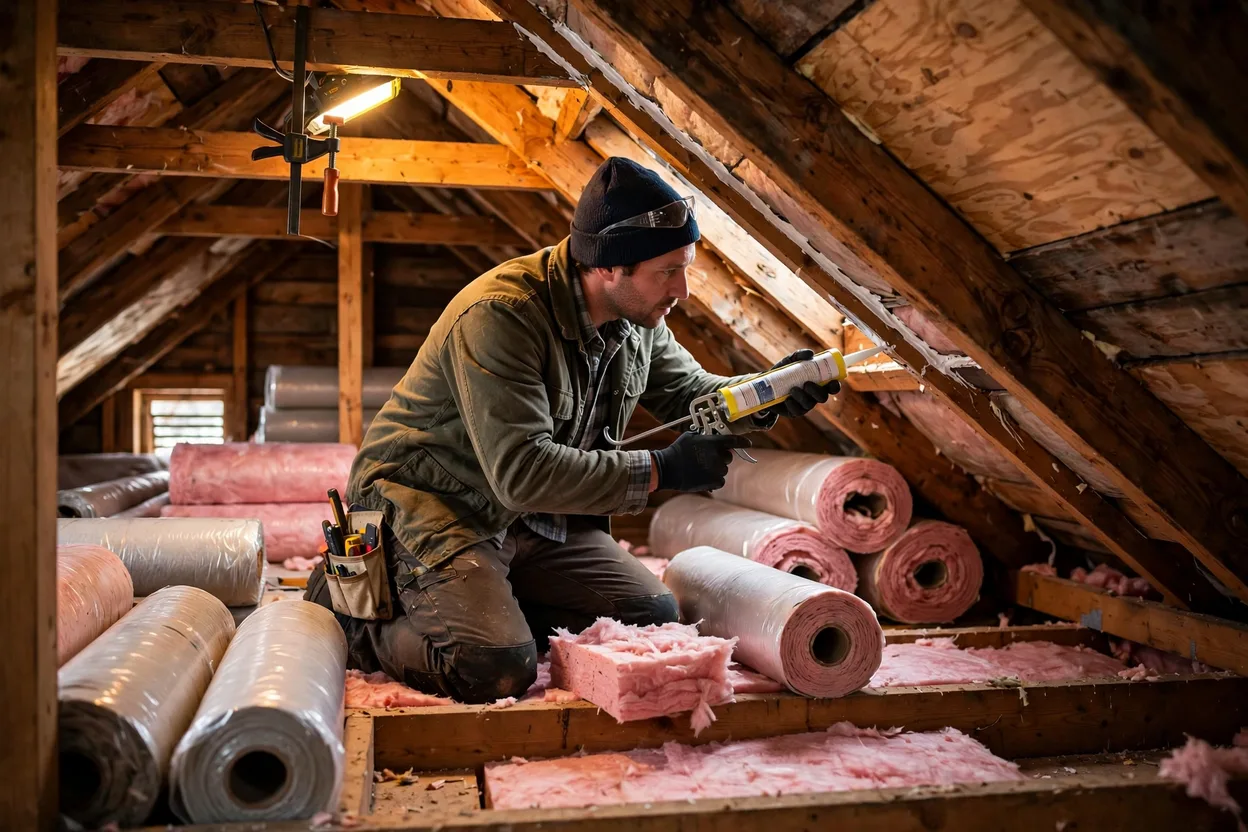
To cut the heat load, seal air leaks before you add insulation, because uncontrolled leakage often accounts for a quarter or more of a cabin's heat loss. ENERGY STAR estimates that sealing and insulating saves an average of 15% on heating and cooling costs. Off the grid, that 15% shows up as fewer cords split or fewer gallons delivered each year. Work in this order:
- Seal the attic plane at top plates, wiring holes, plumbing stacks, and the attic hatch, using foam and caulk.
- Add attic insulation to R-49 to R-60 if the house sits in climate zones 4 to 8.
- Insulate the floor or skirt the crawlspace, which matters most on pier-built cabins exposed to wind.
- Weatherstrip doors and add interior storm panels or cellular shades to windows.
- Re-run the heat load calculation once the work is done, and buy the heater only after that.
How to Calculate Your BTU Heat Load
To calculate a quick heat load, multiply the heated floor area by the load factor for your International Energy Conservation Code (IECC) climate zone. That's the fast version. On a permitted build, confirm the number with an Air Conditioning Contractors of America (ACCA) Manual J calculation.
| IECC Climate Zone | Example Locations | Design Load (BTU/hr per sq ft) |
|---|---|---|
| Zones 1 to 3 | Florida, Gulf Coast Texas, Arizona low desert, Georgia | 15 to 30 |
| Zones 4 to 5 | Kentucky, western Oregon, Colorado Front Range, Pennsylvania | 30 to 45 |
| Zones 6 to 8 | Maine, Vermont, Montana, Minnesota, Michigan's Upper Peninsula, Alaska | 45 to 60 |
An 800 sq ft (74 m²) cabin in Zone 6 at 40 BTU/hr per sq ft needs about 32,000 BTU/hr (9.4 kW) of heating capacity. Behind that figure sit two assumptions: a -10°F (-23°C) design temperature outside and a 70°F (21°C) setpoint inside the cabin. Tight builds do better. A well-insulated, carefully sealed cabin typically lands 20 to 40% lower.
How to Estimate Seasonal Fuel Use With Heating Degree Days
To estimate seasonal fuel use, divide the design load by the design temperature difference to get the heat loss rate (UA), then multiply UA by 24 hours and by your location's annual heating degree days (HDD). Now plug in the 800 sq ft cabin. With 32,000 ÷ 80°F = 400 BTU/hr·°F, the math runs 400 × 24 × 7,500 HDD = 72 million BTU (MMBTU) per heating season. Here's what that load means in fuel:
| Fuel | Usable Heat per Unit | Seasonal Quantity for 72 MMBTU |
|---|---|---|
| Seasoned hardwood (70% stove efficiency) | 15.4 MMBTU per cord | 4.7 cords (17 m³) |
| Wood pellets (80% efficiency) | 13.2 MMBTU per ton | 5.5 tons (5.0 metric tonnes) |
| Propane, vented heater (80% efficiency) | 73,200 BTU per gallon | 984 gallons (3,725 liters) |
| #2 diesel air heater (85% efficiency) | 116,450 BTU per gallon | 618 gallons (2,340 liters) |
What Are the Best Off Grid Heating Options?
The 6 best off grid heating options are EPA-certified wood stoves, masonry heaters, vented propane heaters, diesel air heaters, cold-climate heat pumps, and passive solar design. No single option wins everywhere. Your pick hinges on 6 factors: climate zone, heat load, budget, fuel access, tolerance for labor, and how much power you can spare.
| Option | Best Climate Zones | Typical Installed Cost | Electricity Needed | Main Trade-Off |
|---|---|---|---|---|
| EPA-certified wood stove | 4 to 8 | $3,000 to $7,500 with chimney | None (blower optional) | Firewood labor and storage |
| Masonry heater | 5 to 8 | $15,000 to $35,000 | None | Cost and foundation weight |
| Vented propane wall furnace | 3 to 7 | $1,500 to $3,500 | None for millivolt models | Fuel delivery logistics |
| Diesel air heater | 3 to 7, small spaces | $200 to $2,000 | 10 to 40 W running | Noise and maintenance |
| Cold-climate mini-split heat pump | 1 to 5 | $3,500 to $6,500 per zone | High in cold weather | Solar shortfall in winter |
| Passive solar and thermal mass | 2 to 6, sunny regions | Built into the design | None | Only practical for new builds or major remodels |
EPA-Certified Off Grid Wood Stove
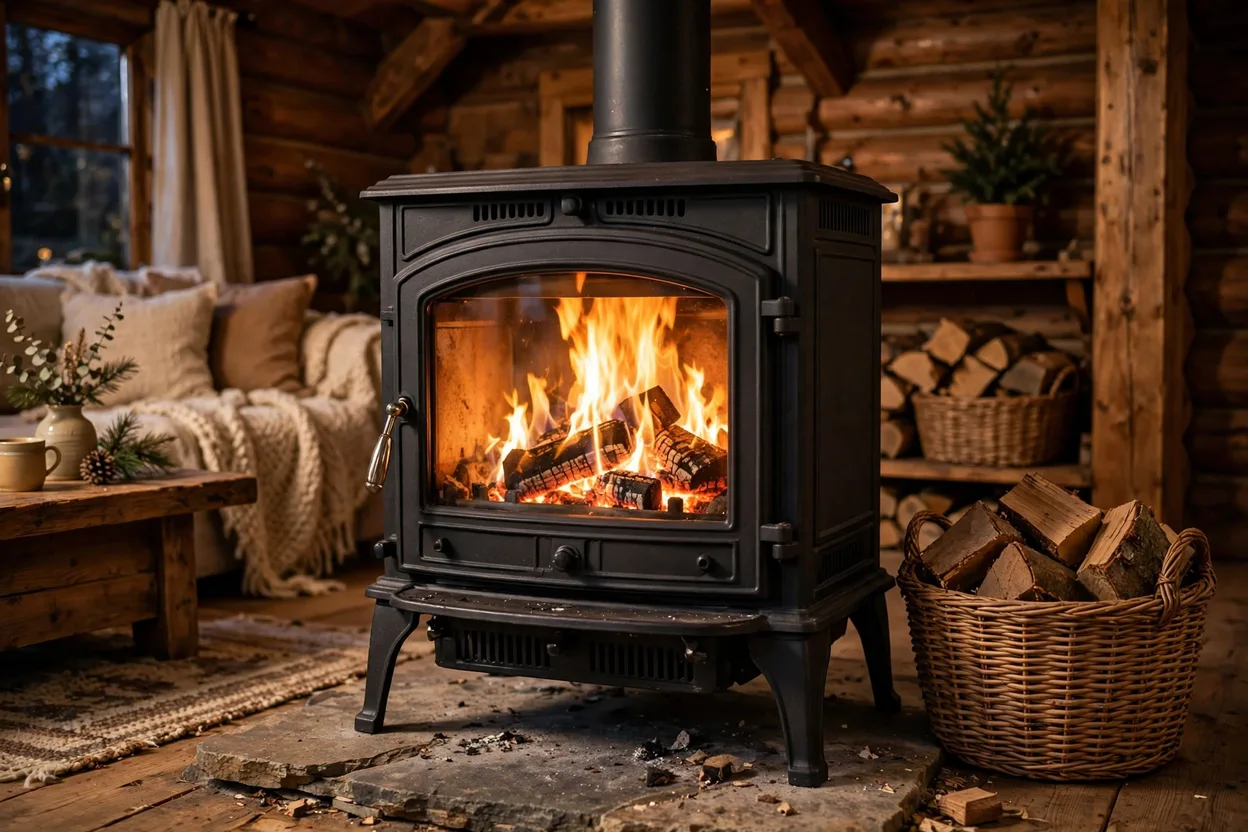
An EPA-certified off grid wood stove is the most dependable primary heat source in cold zones, because cordwood is often free or cheap and the stove needs no power. Any stove sold since 2020 has to meet the EPA 2020 New Source Performance Standards (NSPS) limit of 2.0 grams per hour, or 2.5 grams per hour when tested with cordwood. Six makers have strong track records: Blaze King, Woodstock Soapstone, Jøtul, Pacific Energy, Hearthstone, and Englander. Catalytic Blaze King models stand out. They'll hold a low burn for 20 hours or longer. For fuel, burn wood below 20% moisture content, which takes 6 to 12 months of seasoning for softwood and 12 to 24 months for oak. A cord measures 128 cubic feet (3.62 m³).
Masonry Heaters and Rocket Mass Heaters
Masonry heaters burn hot for 1 to 2 hours and then radiate stored heat for 12 to 24 hours, which suits owners who are away during the day. Tulikivi soapstone units weigh 3,000 to 6,000 lb (1,360 to 2,720 kg), and that mass demands its own footing. Rocket mass heaters apply the same store-and-release principle on a DIY budget, a method documented by Ianto Evans and Leslie Jackson in Rocket Mass Heaters and taught by Ernie and Erica Wisner and Paul Wheaton of Permies.com. There's a catch. No rocket mass heater carries an Underwriters Laboratories (UL) listing, so permits and insurance coverage are harder to get.
Vented vs. Ventless Propane Heaters
Vented propane heaters send combustion gases outdoors and are the safe choice for all-day use. Ventless heaters release those gases into the room and suit only intermittent use. Ventless units run about 99% efficient, yet every gallon of propane they burn puts roughly 0.8 gallons (3 liters) of water vapor into the room, and in a tight cabin that moisture turns into condensation and mold. Standards differ too. Ventless room heaters carry American National Standards Institute (ANSI) Z21.11.2 certification, while vented gas room heaters fall under ANSI Z21.86.
Diesel Air Heaters
A 2 kW diesel air heater burns 0.03 to 0.06 gallons (0.1 to 0.24 liters) per hour and draws only 10 to 40 W once running, which makes it a strong fit for tiny houses and vans. Webasto, Espar/Eberspächer, and Planar/Autoterm build the most durable units, and cheap clones need glow plug service and carbon cleaning more often. Cold weather brings a fuel problem. Below 10°F (-12°C), #2 diesel gels, so switch to #1 diesel or a winter blend.
Cold-Climate Heat Pumps on Solar and Batteries
Cold-climate heat pumps from Mitsubishi (Hyper-Heat), Fujitsu, and Daikin deliver 2 to 3 units of heat per unit of electricity, but they only work off grid when there is enough battery and solar capacity. Mitsubishi Hyper-Heat models hold full rated capacity down to 5°F (-15°C) and keep running to -13°F (-25°C). Solar is the bottleneck. On an average December day, a 4 kW array in the northern US produces about 8 kWh, well short of the 10 to 25 kWh a heat pump pulls daily in deep cold.
Passive Solar Design and Thermal Mass
Passive solar design cuts the heat load by 25 to 50% when south-facing glass equals about 7 to 12% of the floor area and is paired with concrete, masonry, or water thermal mass. Passive solar pays off most in the Arizona and Southwest high desert and in the Colorado Rockies, while the cloudy Pacific Northwest sees much smaller gains from the same glass and mass. Cloud cover is the limiting factor.
Which Heaters Require No Electricity?
Heaters that require no electricity include wood stoves without blowers, masonry heaters, millivolt propane wall furnaces, oxygen depletion sensor (ODS) portable heaters, and thermoelectric generator (TEG) fan heaters such as the Vesta. Battery failures and inverter faults don't stop these heaters, and neither does a storm that keeps the solar array dark for several days straight. Every off-grid home needs at least one.
Propane Heater With No Electricity: Millivolt Wall Furnaces
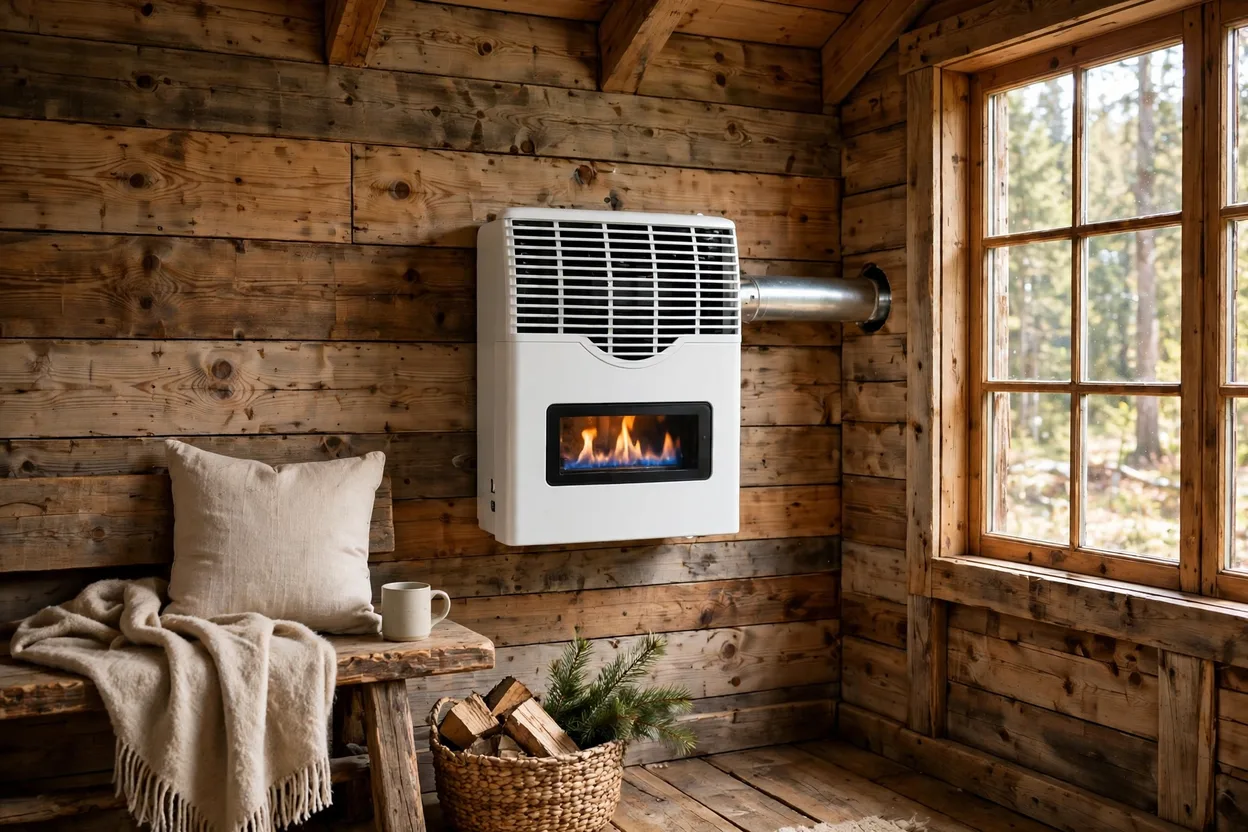
A millivolt direct-vent wall furnace is the safest propane heater with no electricity, because a thermocouple powers the gas valve and the furnace vents outdoors through the wall. Empire Comfort Systems and Williams sell millivolt models from about 10,000 to 40,000 BTU/hr. Controls need no batteries either. A millivolt wall thermostat handles that job, and installing the furnace costs less than building a chimney because the vent runs straight out through an exterior wall.
Off Grid Space Heater With an Oxygen Depletion Sensor
An ODS-equipped off grid space heater shuts off the gas automatically when room oxygen drops to about 18%. The Mr. Heater Buddy (4,000 to 9,000 BTU/hr) heats up to 225 sq ft (21 m²) and adds tip-over shutoff, while the Big Buddy runs up to 18,000 BTU/hr. Ventilation still matters. Crack a window about 1 inch (2.5 cm) whenever one of these heaters is burning, and keep them in the backup or emergency role rather than as a primary source.
Vesta Off Grid Space Heater
The Vesta off grid space heater is a propane heater marketed as self-powered, using a thermoelectric generator to run its circulation fan from the heater's own warmth, so it needs no outlet or batteries. The Vesta is sold for indoor emergency heat. It doubles as a cooktop. Before you buy one, pull the current spec sheet and confirm 3 items: the BTU range, ODS and tip-over protection, and the safety certification.
How Much Power Does Each Off Grid Heater Draw?
Combustion heaters with millivolt or TEG controls draw 0 watts, diesel air heaters draw 10 to 40 W, and electric resistance heaters draw 1,500 W, which drains a 10 kWh battery bank in under 7 hours.
| Heater | Startup Draw | Running Draw | Daily Energy (24 hr) |
|---|---|---|---|
| Wood stove, masonry heater, millivolt furnace, ODS heater, TEG fan | 0 W | 0 W | 0 kWh |
| Diesel air heater (2 kW) | 100 to 150 W for 2 to 3 minutes | 10 to 40 W | 0.3 to 0.9 kWh |
| Wood stove blower | 0 W | 50 to 100 W | 1.2 to 2.4 kWh |
| Pellet stove | 300 to 500 W igniter | 80 to 150 W | 2.0 to 3.5 kWh |
| Propane forced-air furnace | 400 to 700 W | 400 to 700 W while cycling | 3 to 8 kWh |
| Cold-climate mini-split (12,000 BTU at 5°F) | Soft start | 1,000 to 1,500 W | 10 to 25 kWh |
| Resistance space heater | 1,500 W | 1,500 W | 36 kWh |
Inverters from Victron Energy and Sol-Ark, along with EcoFlow portable stations, use 20 to 50 W in standby on their own, so add that idle draw to the daily budget. Pellet stoves are the weak link. Once the battery dies, the stove stops feeding pellets, which makes pellet heat a poor primary source for small systems.
What Does Off Grid Heat Cost per Million BTU?
Seasoned cordwood is the cheapest off grid heat at about $19 per million BTU, and resistance heat on generator power is the most expensive at about $132. Run the numbers yourself. The formula is cost per MMBTU = fuel price ÷ (BTU per unit × efficiency) × 1,000,000. Heat content values below come from the US Energy Information Administration (EIA), but the prices are example 2026 figures, so swap in quotes from your own dealers.
| Fuel and Appliance | Example Price | Heat Content | Efficiency | Cost per MMBTU |
|---|---|---|---|---|
| Hardwood cordwood, EPA stove | $300 per cord | 22 million BTU per cord | 70% | $19 |
| Wood pellets, pellet stove | $350 per ton | 16.5 million BTU per ton | 80% | $27 |
| Propane, ventless heater | $2.80 per gallon | 91,500 BTU per gallon | 99% | $31 |
| #2 diesel, air heater | $4.00 per gallon | 137,000 BTU per gallon | 85% | $34 |
| Propane, vented furnace | $2.80 per gallon | 91,500 BTU per gallon | 80% | $38 |
| K-1 kerosene, vented heater | $4.50 per gallon | 135,000 BTU per gallon | 85% | $39 |
| Heat pump, generator power | $0.45 per kWh | 3,412 BTU per kWh | COP 2.5 | $53 |
| Resistance heat, generator power | $0.45 per kWh | 3,412 BTU per kWh | 100% | $132 |
Surplus solar costs nothing to burn. In Zones 5 to 8, though, that surplus vanishes for most of the heating season, so it can't carry the load during the months the house needs heat most.
How to Set Up an Off Grid Water Heater
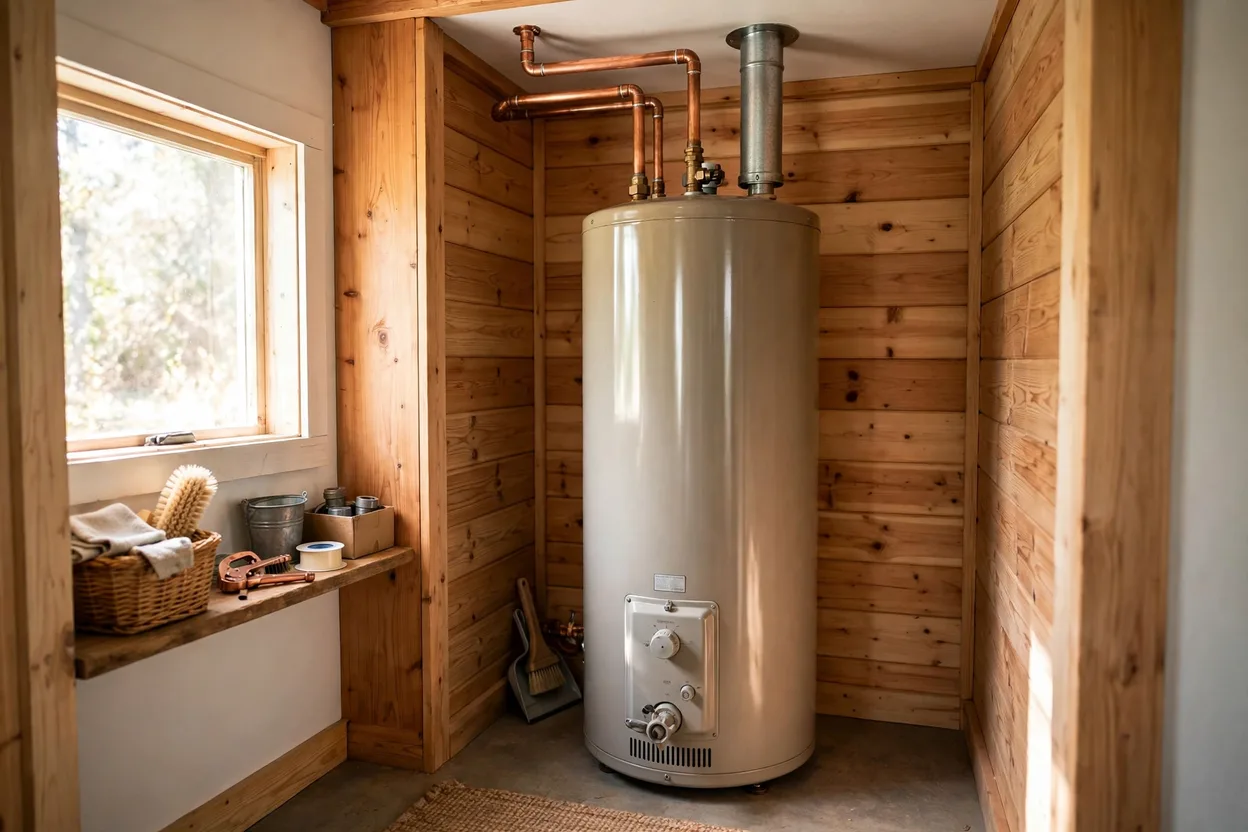
To set up an off grid water heater, pick 1 primary source (propane, wood, or solar thermal) and keep 1 backup that runs without electricity. Start simple. A standing-pilot propane tank water heater is the simplest option that requires no electricity at all.
Propane Off Grid Hot Water Heater Options
Standing-pilot propane tank heaters (30 to 40 gallons, 114 to 151 liters) use zero electricity. Most indoor tankless units need 120 V for their combustion fan. Each type suits a different setup, and the right match depends on whether you live on the property full time or only visit seasonally:
| Off Grid Hot Water Heater | Power Needed | Flow or Capacity | Best Use |
|---|---|---|---|
| Standing-pilot propane tank heater | None | 30 to 40 gallons stored | Full-time homes |
| Eccotemp L5 or L10 tankless | D-cell batteries for ignition | 1.5 to 2.6 GPM (5.7 to 9.8 L/min) | Outdoor showers, cabins |
| Camplux portable tankless | D-cell batteries for ignition | 1.3 to 2.6 GPM | Outdoor seasonal use |
| Rinnai indoor tankless | 120 V, about 40 to 60 W running | Up to 9.8 GPM | Homes with a strong solar system |
Eccotemp and Camplux portable units carry outdoor-only ratings, so they never belong on an indoor wall, even in a utility room with good airflow. Mount them outside.
Wood Stove Water Jackets and Solar Thermal Collectors
A wood stove water jacket heats a storage tank with no pump through thermosiphon circulation, as long as the tank bottom sits at least 18 inches (46 cm) above the coil. Install a temperature and pressure (T&P) relief valve, and never put a shutoff valve between the coil and the tank. Sun works too. In sunny regions, solar thermal collectors supply 50 to 80% of annual hot water, with batch collectors handling Zones 1 to 3 and a closed glycol loop with PEX tubing protecting Zones 4 to 8 from freezing.
How to Build a Backup Heating Plan by Climate Zone
To build a backup plan, layer 3 tiers: a primary heater, a backup that needs no electricity, and emergency heat that runs for at least 14 days. Every off grid heating stack needs 1 heat source that keeps working with a dead battery bank. The right mix shifts by climate zone.
| Climate Zone | Primary Heat | Backup Heat | Emergency Heat |
|---|---|---|---|
| Zones 1 to 3 | Mini-split on solar | Vented propane wall furnace | ODS propane heater plus 1 lb (0.45 kg) cylinders |
| Zones 4 to 5 | EPA wood stove or mini-split | Millivolt propane wall furnace | ODS heater plus 2 × 20 lb (9 kg) tanks |
| Zones 6 to 8 | EPA wood stove or masonry heater | Millivolt propane furnace or diesel air heater | ODS heater, generator, and pipe heat tape |
Example Season Log for an 800-Square-Foot Cabin
The modeled log below shows that 1 cabin in Zone 6 burns about 4.5 cords and 120 gallons of propane in a season when wood is primary and propane is backup. Wood supplies most of the heat. Modeled on a 72 MMBTU seasonal load, the table lists 4 sample months, and the remaining months of the season account for the rest of the totals.
| Month | Average Outdoor Temp | Cordwood Burned | Propane Burned | Indoor Range |
|---|---|---|---|---|
| October | 42°F (6°C) | 0.3 cords | 8 gallons | 64 to 70°F |
| December | 16°F (-9°C) | 1.0 cord | 25 gallons | 60 to 70°F |
| January | 10°F (-12°C) | 1.1 cords | 32 gallons | 58 to 70°F |
| March | 28°F (-2°C) | 0.6 cords | 15 gallons | 62 to 70°F |
Propane covers nights and absences. Because that backup fires whenever the stove burns down, the cabin never drops below 55°F (13°C), and the pipes stay safe without any battery-powered heater running.
What Safety Codes Apply to Off Grid Heating?
Off grid heating installations fall under 6 main codes:
- NFPA 211 for chimneys and solid-fuel appliances
- NFPA 54/IFGC for gas appliances
- NFPA 58 for propane storage
- NFPA 31 for oil-burning equipment
- NFPA 72 for alarms
- The International Residential Code (IRC) for clearances and room limits
Two acronyms there need decoding. NFPA stands for National Fire Protection Association, and IFGC refers to the International Fuel Gas Code published by the International Code Council.
| Rule | Requirement |
|---|---|
| Wood stove clearance | 36 inches (91 cm) to combustibles for unlisted stoves. UL 1482 or UL 737 listed stoves follow the listing label. |
| Chimney height | 3 ft (0.9 m) above the roof penetration and 2 ft (0.6 m) higher than anything within 10 ft (3 m) |
| Unvented gas heater size | 40,000 BTU/hr maximum under IFGC |
| Bedrooms and bathrooms | Unvented heaters prohibited, except wall-mounted ODS units up to 10,000 BTU/hr in bedrooms and 6,000 BTU/hr in bathrooms |
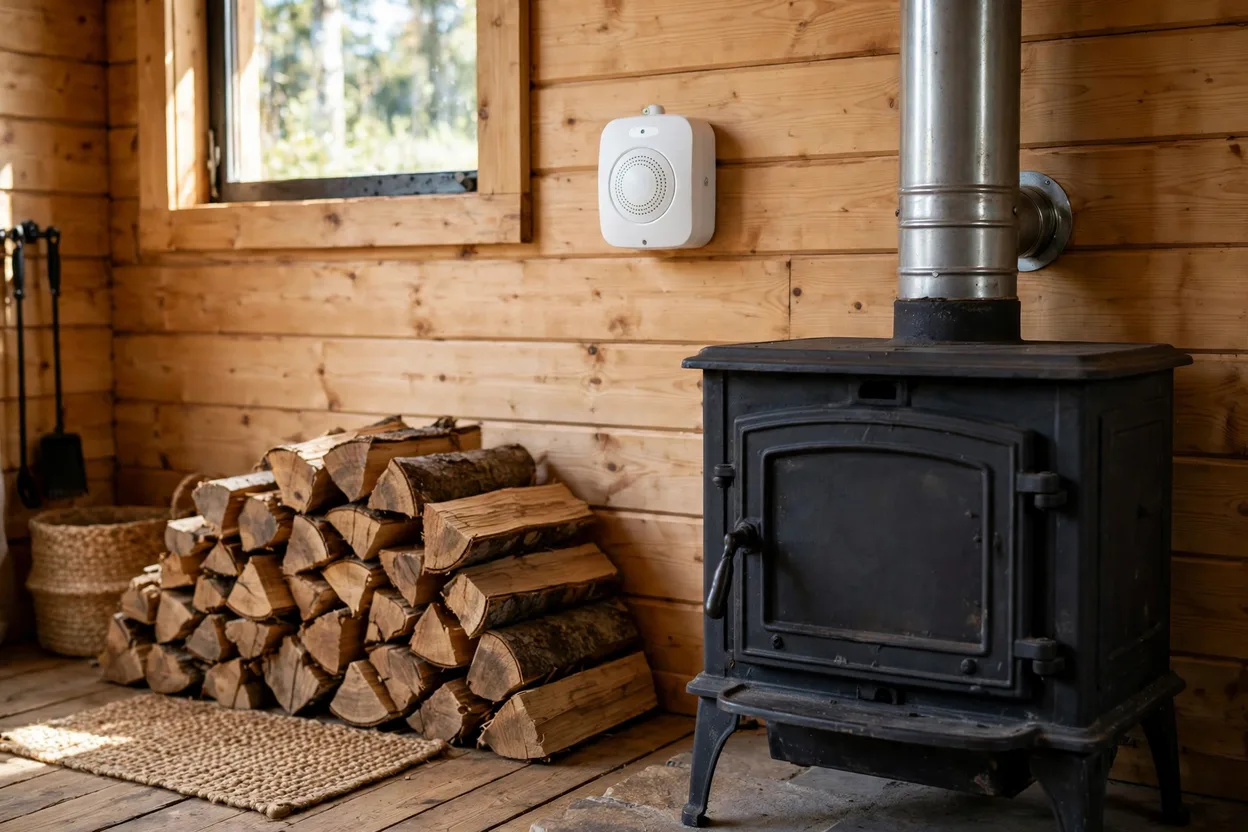
| Carbon monoxide (CO) alarms | UL 2034 listed, on every level and outside each sleeping area |
| Smoke alarms | UL 217 listed, in every bedroom and on every level |
California and several local jurisdictions restrict unvented heaters further, so check your county's rules before installing one. Chimneys need attention too. NFPA 211 calls for an inspection every year, and households burning more than 4 cords annually often need the flue cleaned twice a season.
Propane Tank Sizing and Storage
Most full-time off-grid homes that heat with propane need a 500-gallon (1,893-liter) tank, which holds 400 gallons at the standard 80% fill.
| Tank | Propane Capacity | Typical Use |
|---|---|---|
| 20 lb (9 kg) cylinder | 4.7 gallons (18 L) | ODS heaters, emergencies |
| 100 lb (45 kg) cylinder | 23.6 gallons (89 L) | Water heater, small furnace |
| 250-gallon tank | 200 gallons (757 L) usable | Backup heat |
| 500-gallon tank | 400 gallons (1,514 L) usable | Primary heat, Zones 4 to 6 |
| 1,000-gallon tank | 800 gallons (3,028 L) usable | Primary heat, Zones 7 to 8 |
NFPA 58 sets 3 key storage rules. Tanks of 125 to 500 gallons sit at least 10 ft (3 m) from buildings, while tanks of 501 to 2,000 gallons need 25 ft (7.6 m) of separation. Cylinders always stay outdoors. Access is a separate problem, since delivery trucks need an all-weather road and typically carry about 100 ft (30 m) of hose. In cold weather, propane vaporizes slowly in small cylinders, so high continuous loads call for a larger tank.
Permits, Insurance, and 2026 Incentives
The federal 25C and 25D residential energy credits ended for property placed in service after December 31, 2025, so heating equipment bought in 2026 does not qualify for them. State and utility rebates still exist alongside county programs, and the Database of State Incentives for Renewables & Efficiency (DSIRE) tracks the current ones. Permits come next. Pull one for every wood stove and gas appliance, and tell your insurer about any solid-fuel heat in the house. Many carriers require a UL-listed stove plus an inspection certificate, and an unlisted rocket mass heater can void a fire claim.
FAQs
What is the best off grid heating for very cold climates?
The best choice for Zones 6 to 8 is an EPA-certified wood stove backed by a millivolt propane wall furnace, which holds the house above freezing while you're away. Neither needs power.
Is there a propane heater that doesn't require electricity?
Yes. Empire and Williams millivolt wall furnaces, Mr. Heater Buddy ODS units, and the TEG-fan Vesta all operate with no outlet, inverter, or battery connection, so they keep heating through any outage.
Can solar panels and batteries run a heater off grid?
Yes, with efficient loads. Diesel air heaters fit almost any battery bank, but a 1,500 W resistance heater empties a 10 kWh bank overnight, and heat pumps need an oversized array.
Are ventless propane heaters safe to run overnight?
No. Codes ban most unvented units in bedrooms, and the ones still allowed release moisture and combustion byproducts into the room for hours. Pick a direct-vent model instead, with a UL 2034 CO alarm close by.
How do you get hot water off grid without electricity?
Use a standing-pilot propane tank heater, a wood stove water jacket running on thermosiphon flow, or a batch solar collector. Pumps and electronic ignition play no part.
Conclusion
Reliable off grid heating comes from 4 steps: cut the heat load, size the heater from BTU math, choose fuel by climate zone and cost per million BTU, and keep a backup that needs no electricity. Wood leads in cold zones and propane supplies the most flexible heaters that require no electricity, while heat pumps earn their place where winter sun is strong. Check DSIRE for state incentives before buying. Once the heater's in, follow NFPA clearances and put a CO alarm on every level.