What to Look for When Buying Land: The 12-Point Rural Land Buying Checklist (2026)
The short answer: what to look for when buying land comes down to 12 checks. Before you buy rural land, confirm 12 things in writing: legal access, a clean title, zoning that allows your plans, deed restrictions, water, a site that can take a septic system, flood risk, wetlands, the cost of utilities, the true boundaries, the property taxes, and who owns the mineral rights. Most of these can be checked for free on official government tools before you spend money on a survey or an inspection.
Land is the one purchase where what you cannot see matters more than what you can. A beautiful parcel with no legal road access, no buildable soil or no water is not a bargain at any price, even in the cheapest states to buy land. This rural land buying checklist walks through what to look for when buying land, in the order most buyers should check it, and names the official place to verify each one. For the full process from budget to closing, see our step-by-step guide on how to buy land.
What to look for when buying land: the checklist at a glance
| Check | What to look for | Where to verify |
|---|---|---|
| 1. Legal access | A recorded easement or frontage on a public road | Deed, title commitment, county recorder |
| 2. Clean title | No liens, competing claims or unpaid taxes | Title search + owner’s title insurance |
| 3. Zoning | Allows a home, animals, outbuildings or business you plan | County or city planning/zoning office |
| 4. Deed restrictions & HOA | Covenants on home size, livestock, RVs, subdivision | Recorded covenants, HOA documents |
| 5. Water | A permitted well, water rights or a utility connection | State well logs, state water agency, EPA private-well guidance |
| 6. Septic suitability | Soil that passes a perc or site evaluation | County health department; NRCS Web Soil Survey |
| 7. Flood risk | Flood zone designation | FEMA Flood Map Service Center |
| 8. Wetlands | Mapped wetlands that limit building | USFWS Wetlands Mapper |
| 9. Utilities | Distance to power, internet, and the cost to connect | Local electric co-op or utility quote |
| 10. Boundaries | Corners and acreage match the listing | Licensed land surveyor |
| 11. Taxes & costs | Current tax bill and any agricultural exemption that ends on sale | County assessor and treasurer |
| 12. Mineral rights | Whether minerals were sold off separately | Deed history, title commitment |
1. Legal access: can you actually reach the land?
Landlocked parcels are one of the most common traps in cheap rural land. A dirt track on the ground is not the same as a legal right to use it. Look for frontage on a public road or a recorded easement that runs with the land, and ask the title company to confirm it in the title commitment.
- Is the access road public, or does it cross a neighbor’s land?
- If it crosses private land, is the easement recorded, and who maintains the road?
- Can emergency vehicles and a concrete truck get in year-round?
2. Clean title: does the seller own it free and clear?
Order a title search and buy an owner’s title insurance policy. The Consumer Financial Protection Bureau explains that owner’s title insurance “protects the homeowner if someone sues and says they have a claim against the home from before the homeowner purchased it.” Watch for unpaid property taxes, liens, and sellers who are not the recorded owner, a pattern behind many land scams.
3. Zoning: is what you want to do allowed?
Zoning sits near the top of what to look for when buying land. It decides whether you can build a house, keep livestock, live in an RV while you build, run a business or split the land later. Call the county planning or zoning office with the parcel number and ask what is allowed, what permits you need, and the minimum lot size for a home. Ask for the answer in writing or by email.
4. Deed restrictions and HOA rules
Private covenants can be stricter than zoning. They may set a minimum home size, ban mobile homes or livestock, or forbid splitting the parcel. Ask the title company for copies of every recorded restriction, and read the HOA rules if there is one.
5. Water: where will it come from?
Rural land usually depends on a private well, a shared well, hauled water or rainwater. The U.S. EPA notes that private wells are “not regulated by the Federal Government” or by most states, and that “private well owners are responsible for delivering safe drinking water to their households.” Before you buy:
- Look up nearby well depths and yields in your state’s well-log database.
- In Western states, confirm water rights with the state water agency; owning the land does not always mean you can use the water.
- If there is an existing well, test it. The CDC recommends testing well water “at least once each year for total coliform bacteria, nitrates, total dissolved solids, and pH levels.”
- If you plan to collect rainwater, check your state’s rules first (see our rainwater harvesting laws by state).
6. Septic: will the soil pass a perc test?
Without a sewer line, you need a septic system, and the county health department will only permit one if the soil and site pass its evaluation (often called a perc test). Start with the free NRCS Web Soil Survey, which “provides soil data and information produced by the National Cooperative Soil Survey,” to see the soil types on the parcel. Then make your offer contingent on a passing perc test or site evaluation. Soil is one of the most overlooked items on any list of what to look for when buying land.
7. Flood risk
Search the address on the FEMA Flood Map Service Center, “the official public source for flood hazard information produced in support of the National Flood Insurance Program.” A parcel in a high-risk flood zone can mean required flood insurance, extra building rules, or a building site that is smaller than it looks.
8. Wetlands
Wetlands can limit where you build, clear land or put a driveway. The USFWS Wetlands Mapper shows mapped wetlands, but the U.S. Fish and Wildlife Service notes the map does not define legal jurisdiction, so treat a mapped wetland as a reason to ask the county and, if needed, a wetlands professional before you buy.
9. Utilities: what will power and internet cost?
Utility costs are the item most often missed when people list what to look for when buying land. Ask the local electric utility or co-op for a written quote to bring power to your building site, and check which internet providers serve the address. Long distances from the nearest pole can add a large, unplanned cost to cheap land.
10. Survey and boundaries
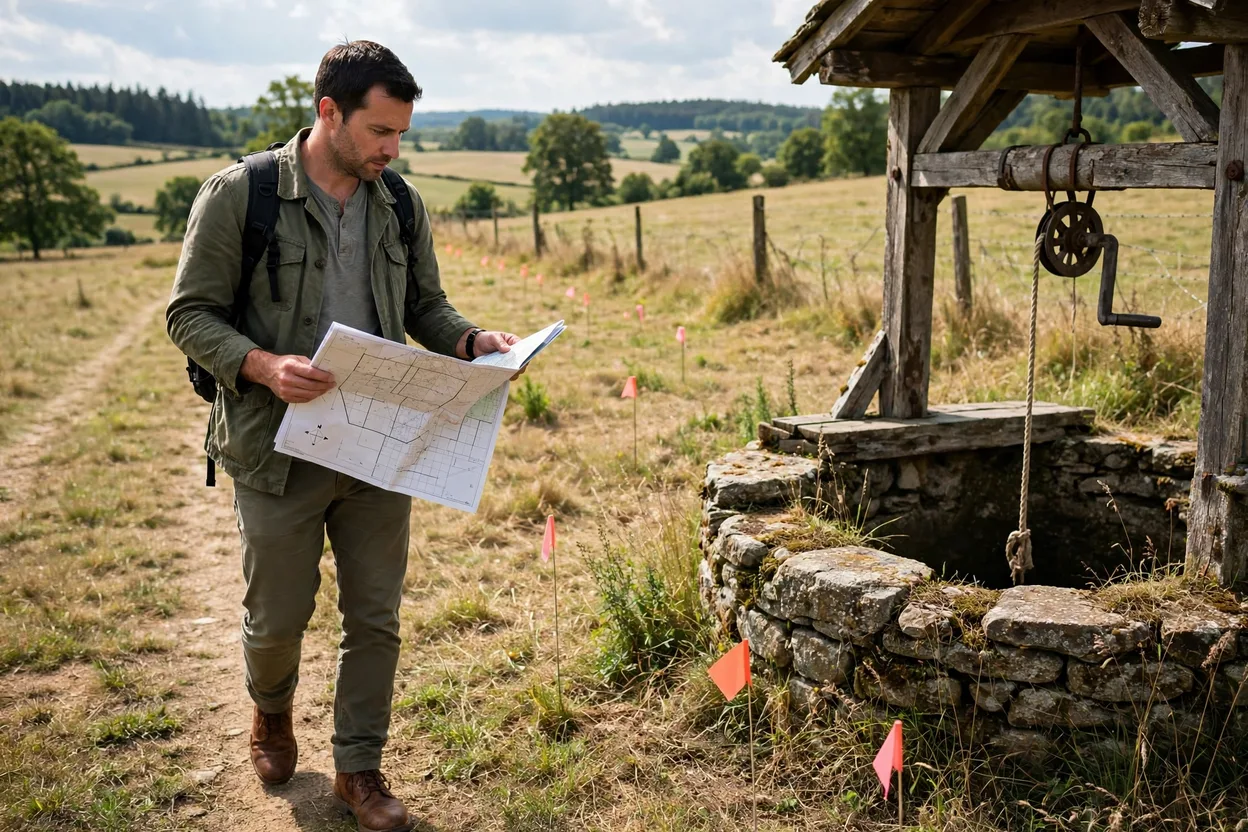
A survey turns what to look for when buying land into facts on the ground. Hire a licensed land surveyor to mark the corners and confirm the acreage, especially for older parcels described by metes and bounds. A survey also reveals encroachments, such as a neighbor’s fence or driveway on your land.
11. Property taxes and hidden costs
Ask the county assessor for the current tax bill and whether the land has an agricultural or timber exemption that could end when it sells. Add the costs this buying land checklist uncovers, such as a well, septic, power and a driveway, to the price before you compare parcels. Our land loan calculator helps you see the monthly cost.
12. Mineral rights
In many states, the rights to oil, gas and minerals can be sold separately from the surface. Check the deed history and title commitment to see whether mineral rights were reserved by a past owner, and what that could mean for access and drilling on your land.
Questions to ask the seller
Knowing what to look for when buying land also means asking the seller the right questions, in writing:
- Why are you selling, and how long have you owned it?
- Is there recorded legal access, and who maintains the road?
- Has a perc test or soil evaluation ever been done?
- Are there wells on the property or nearby, and how deep are they?
- Are there any easements, liens, leases or restrictions?
- Were the mineral rights sold or reserved?
- Will you accept an offer contingent on a survey, perc test and title review?
Red flags that mean walk away
Part of knowing what to look for when buying land is knowing when to stop. Walk away if:
- The seller refuses a title search, survey or contingency period.
- There is no recorded access, only “the neighbors don’t mind.”
- The price is far below nearby sales with no clear reason.
- You are asked to wire money before a title company is involved.
- The county cannot confirm that a home can be permitted on the lot.
Frequently asked questions
What is the most important thing to check before buying land?
Legal access. Without a recorded right to reach the parcel, you may not be able to build, get a loan or resell. Confirm it in the title commitment before you close.
Do I need a survey to buy rural land?
A survey is not always required by law, but it is the only way to confirm the boundaries and acreage you are paying for, and many lenders and title insurers ask for one.
How do I know if land is in a flood zone?
Search the address on the FEMA Flood Map Service Center, the official source for flood hazard maps, and ask the county about any local flood rules.
What is a perc test and do I need one?
A perc (percolation) test or site evaluation checks whether the soil can absorb septic wastewater. If the land has no sewer, the county will usually require a passing test before it permits a septic system.
Now you know what to look for when buying land. Cheap land is only cheap if it passes this rural land buying checklist. Spend a little on title, survey and a perc test before closing, and you avoid the parcels that cost the most to fix.
Related Guides on Rediscover Rural
- Cheapest States to Buy Land in 2026: All 48 Ranked (USDA Data)
- Rainwater Harvesting Laws by State
- Land Loan Calculator
- USDA Grants for Homesteaders 2026
- Free Land Is Real — 7 US Programs Still Active in 2026
Official Sources
- msc.fema.gov — FEMA Flood Map Service Center (flood zones)
- websoilsurvey.nrcs.usda.gov — NRCS Web Soil Survey (soils)
- fws.gov — USFWS Wetlands Mapper (wetlands)
- epa.gov/privatewells — EPA private drinking water wells
- cdc.gov — CDC guidelines for testing well water
- consumerfinance.gov — CFPB: what is owner’s title insurance
- epa.gov/septic — EPA septic systems